


Holiday Inventory Is Moving. Is Your Warehouse Ready?
September may feel early to start worrying about holiday warehouse capacity.
For a lot of retail operations teams, it’s already late.
Holiday SKUs are moving. Furniture, décor, toys, promotional inventory, packaging materials and other seasonal goods can start hitting distribution centers well before the holiday shopping season actually begins.
One General Manager at a national home décor chain told us:
“The Christmas freight is already hitting the DC before Labor Day. We start building storage buffers months ahead.”
That’s the part of peak season planning consumers never see. Black Friday might be months away, but the inventory behind it has to go somewhere now.
September Is a Space Problem Before It’s a Sales Problem
Retail peak season is usually discussed in terms of demand.
Operations teams experience it first as a capacity problem.
Product begins arriving while existing inventory is still moving through the building. Promotional inventory needs to be staged. Bulky seasonal SKUs consume valuable floor space. Docks get busier, and every pallet parked in the wrong place makes normal warehouse operations a little harder.
The challenge isn’t necessarily that a retailer doesn’t have enough warehouse space all year.
It’s that the space they have needs to absorb a temporary surge at exactly the right time.
That distinction matters.
Adding permanent square footage to solve a seasonal spike can mean committing to capacity you won’t need once January or February rolls around. The retailers we work with take a different approach: build temporary capacity around the surge rather than permanently building for the surge. The Retail Playbook shows how major retailers are expanding and contracting storage across DCs, stores and reverse logistics operations as volume changes. How major retailers expand and contract storage as demand changes
The First Warning Sign Usually Isn’t “We’re Out of Space”
By the time someone says the warehouse is full, the problem is obvious.
The more useful warning signs happen earlier.
Inbound freight starts taking longer to process. Product gets staged in areas that weren’t designed for storage. Forklift clearances get tighter. Teams start moving the same inventory multiple times just to reach something else. Containers or trucks wait because there isn’t an obvious place to put the freight.
None of those problems individually means a warehouse has failed.
Together, they’re a pretty good indication that peak inventory is starting to compete with day-to-day operations.
Retail leaders in our playbook described facilities becoming full before Black Friday and using trailers specifically to keep aisles clear enough for forklifts to move.
That’s why the better question in September isn’t:
“Are we out of space?”
It’s:
“What happens to the next load that arrives?”
If there isn’t a clear answer, it’s time to build a buffer.
Create a Buffer Without Disrupting the Building
One of the simplest ways retailers create that buffer is by moving inventory that doesn’t need to occupy active warehouse space into storage trailers.
Instead of sending overflow miles away to another warehouse, dock-height trailers can sit at the facility and function as an extension of the existing footprint.
That extra capacity can be assigned deliberately.
Early holiday inventory can wait there until it’s needed. Bulky seasonal merchandise can stay out of active pick areas. Promotional product can be staged separately. Incoming freight can be unloaded without immediately consuming warehouse floor space.
The goal isn’t just finding somewhere to put more stuff.
It’s protecting the space where the actual work happens.
Retail operations teams using this strategy treat trailers as extensions of their warehouse floor plan. Some scan and map inventory down to the individual trailer so teams know exactly what is stored where.
That turns overflow storage from a last-minute parking spot into part of the operation. The Q4 storage strategies used by major retailers
The Dock Matters Just as Much as the Square Footage
There’s another reason to think about capacity before the warehouse actually reaches 100%.
Inbound freight doesn’t stop because the building is congested.
When containers arrive, operations teams need somewhere to unload them. If product can move directly into staged storage capacity, the dock keeps moving even when the main warehouse is tight.
Retailers using temporary storage staging can clear large numbers of containers in less than 48 hours, according to the strategies outlined in our Retail Playbook. The same approach helps avoid detention charges that can run around $300 per day.
So overflow capacity isn't only about storing inventory.
It can also protect the flow of inventory into the building.
And during Q4, keeping freight moving can be just as important as finding somewhere to store it.
Build for the Surge, Then Give the Space Back
This is where temporary storage fits the shape of retail demand particularly well.
Peak season has an expiration date.
The Retail Playbook shows major retailers adding roughly 9,000 to 45,000 square feet of temporary floor space across multiple locations, with some scaling as high as 50,000 square feet during the November peak. Then capacity can come back down as inventory clears.
That’s very different from signing for warehouse space based on the busiest few weeks of the year.
With Warehouse on Wheels, retailers can use storage trailers on 30-day rental agreements and adjust capacity as velocity changes.
Need more space as holiday freight arrives? Add it.
Volume clears? Give it back.
January returns create another surge? Adjust again.
Storage follows the business instead of forcing the business to fit the storage.
Before the Next Holiday Shipment Arrives, Ask These Questions
September is a good time for retail operations teams to look beyond the inventory already inside the building and think about what is scheduled to arrive next.
Ask:
- How much holiday inventory is still inbound?
- Which locations have the least available capacity?
- What seasonal SKUs will consume the most floor space?
- Where will promotional inventory be staged?
- Can incoming containers be unloaded immediately if the warehouse is congested?
- Which inventory actually needs to be inside the building?
- What happens to overflow if volume exceeds the forecast?
- And after Christmas, where will returns go?
The Retail Playbook recommends forecasting inbound flow month by month, identifying bulky and damage-prone categories, staging capacity before product arrives and having the post-holiday reverse logistics plan ready before the season begins. The full Q4 Action Checklist.
The important part is answering those questions before the freight is sitting at your dock.
Don’t Plan for Black Friday. Plan for What Arrives Before It.
Retailers know when Q4 is coming.
What changes every year is exactly how much inventory arrives, when it arrives and which locations feel the pressure first.
That’s why the strongest peak-season plans aren’t built around predicting everything perfectly. They’re built around having somewhere for the unexpected volume to go.
Warehouse on Wheels helps retailers add flexible storage capacity directly at their facilities without committing to permanent warehouse space. And because that capacity can expand and contract with demand, teams can prepare for holiday inventory without designing their entire network around a few peak weeks.
Want to see how major retailers are doing it?
Download Retail Secrets: How Big Retailers Keep Up with Q4 Storage Chaos for the full September-through-January surge strategy, site-specific tactics and Q4 action checklist.
When you're ready to start planning for Q4, call your local Warehouse on Wheels team or request a quote online. You'll get availability and pricing within hours, and storage trailers on-site before the season gets ahead of you.


Newmark's 82-Page Industrial Report Is One Slide Short
Newmark's 2Q26 U.S. Industrial Market Conditions and Trends report runs 82 pages. It is careful, well-sourced work, and if you plan capacity for a living you should read it. Page after page lands on the same finding: occupiers want flexibility and buffer space. Then every path the report lays out ends with a signature on a multi-year commitment for a fixed building.
There should have been a slide 83.
Flexibility Is the Through-Line of the Whole Report
Newmark says it plainly in the section on trade policy. With tariffs in near-constant flux, "many occupiers are placing a premium on flexible lease terms, buffer space near ports and border crossings and diversified supply chains."
Look at why. U.S. tariff policy changed on average every 6.7 days across the tracked period. The longest stretch of stability in the past year and a half was 29 days. New Section 301 tariffs of 10% to 12.5% now apply to nearly all goods from 60 countries. Nobody builds a three-year footprint plan on a 29-day runway.
The leasing data says the same thing from a different angle. Logistics, distribution, 3PLs, and manufacturing accounted for roughly 55% of major leasing volume in the first half of 2026. Newmark reads the 3PL strength as a signal, noting it "reflects occupiers' need for flexibility amid uneven demand, inventory uncertainty and shifting supply-chain strategies." When companies hand freight to a 3PL, part of what they are buying is the ability to change their minds.
Then there is the whipsaw. Importers pulled peak-season cargo forward ahead of tariff changes, and Newmark expects imports to fall in the second half of the year. Too much product landing now, then a drop-off. Any warehouse manager reading that paragraph already knows what it feels like on the dock.
The Space That Is Available Is Not the Space You Want
The report's market fundamentals make the squeeze concrete. Vacancy sits at 7.4% and has fallen two straight quarters. Average direct asking rents are $10.66 per square foot, up 3.7% year over year and climbing again. New leasing volume is up roughly 24% year to date, and second-quarter absorption hit 68 million square feet, the strongest quarter since 2023. New deliveries are tracking to a decade low of 210 to 220 million square feet against 240 to 250 million square feet of absorption.
Here is the part worth sitting with. Roughly 30% of all available industrial space is now "long-available," meaning it has sat on the market at least 24 months. Those buildings average 38 years old, and 66% were built before 2006. Low clear heights, tight columns, not enough doors. Available on paper, unusable in practice.
Subleasing out of a commitment is no easier. Availability is still elevated at about 196 million square feet, and Newmark notes sublease space is proving sticky this cycle because of buildout costs, limited transferability of lease rights, and how specialized modern facilities have become. The escape hatch has a lock on it.
Add diesel averaging over $5.00 a gallon since March 2026, up from the mid-$3.00 range at the start of the year, with fuel running 20% to 30% of transportation costs. Shuttling product to an off-site warehouse across town costs more every month it continues.
Square Feet Under Commitment Is the Only Unit the Report Has
None of this is a knock on Newmark. The report measures the industrial market accurately. It just measures it in one unit: square feet under a long-term commitment. That is the unit the brokerage market trades in.
The trouble is that a plant manager with three containers landing Thursday and a jammed floor cannot solve a Thursday problem with a five-year decision. A five-year decision answers next year's plan. It does nothing for this week.
Slide 83 Is Storage Capacity You Can Add This Week
Warehouse on Wheels rents storage trailers by the month. They arrive at your facility, distribution center, or yard, typically within 24 to 48 hours, and they sit where you need them: dock high, in the yard, or wherever your operation works best.
Match that against the pressures Newmark names.
Buffer space near ports and border crossings. Storage trailers give you staging capacity at the plant or the yard without adding permanent square footage anywhere.
Container backups. When a 3PL client's freight arrived early, Warehouse on Wheels had storage trailers on site within 24 hours, and the freight came off the equipment before detention charges started running. A regional warehouse partner facing container delays added temporary capacity across two locations and eliminated more than $10,000 a day in detention charges. Avoided demurrage and detention often cover a full month of storage trailer rental on their own.
The inventory whipsaw. Customers commonly flex between 50 and 500 storage trailers over the course of a year with no penalty. Take them for peak, send them back when volume normalizes. A national retailer handled a surge of inbound freight before peak season with storage trailers on site and skipped the warehouse expansion entirely.
The cost line. Customers report cutting storage costs by up to 75% compared with leased warehouse space, and Warehouse on Wheels runs up to 4x cheaper per square foot than a fixed building.
Behind all of it: 40+ locations across the U.S., Canada, and Mexico, tens of thousands of storage trailers, and more than 6,000 customers. Local crews who know your yard, backed by a national network. On-site maintenance included, so a bad door seal does not cost you a shift.
The Next 82-Page Report Will Say the Same Thing
Volatility is not scheduled to end. The next quarterly report will document another stretch of policy changes, another gap between what is available and what is usable, another set of occupiers saying they want room to move.
You do not have to wait for the market to hand you flexibility. It is already sitting in a yard near you, on wheels, ready to roll Thursday.
Call or get a quote your local Warehouse on Wheels team and ask what is available in your market this week.
Source: Newmark Research, 2Q26 U.S. Industrial Market Conditions & Trends, July 2026.
- John Brooks, CEO
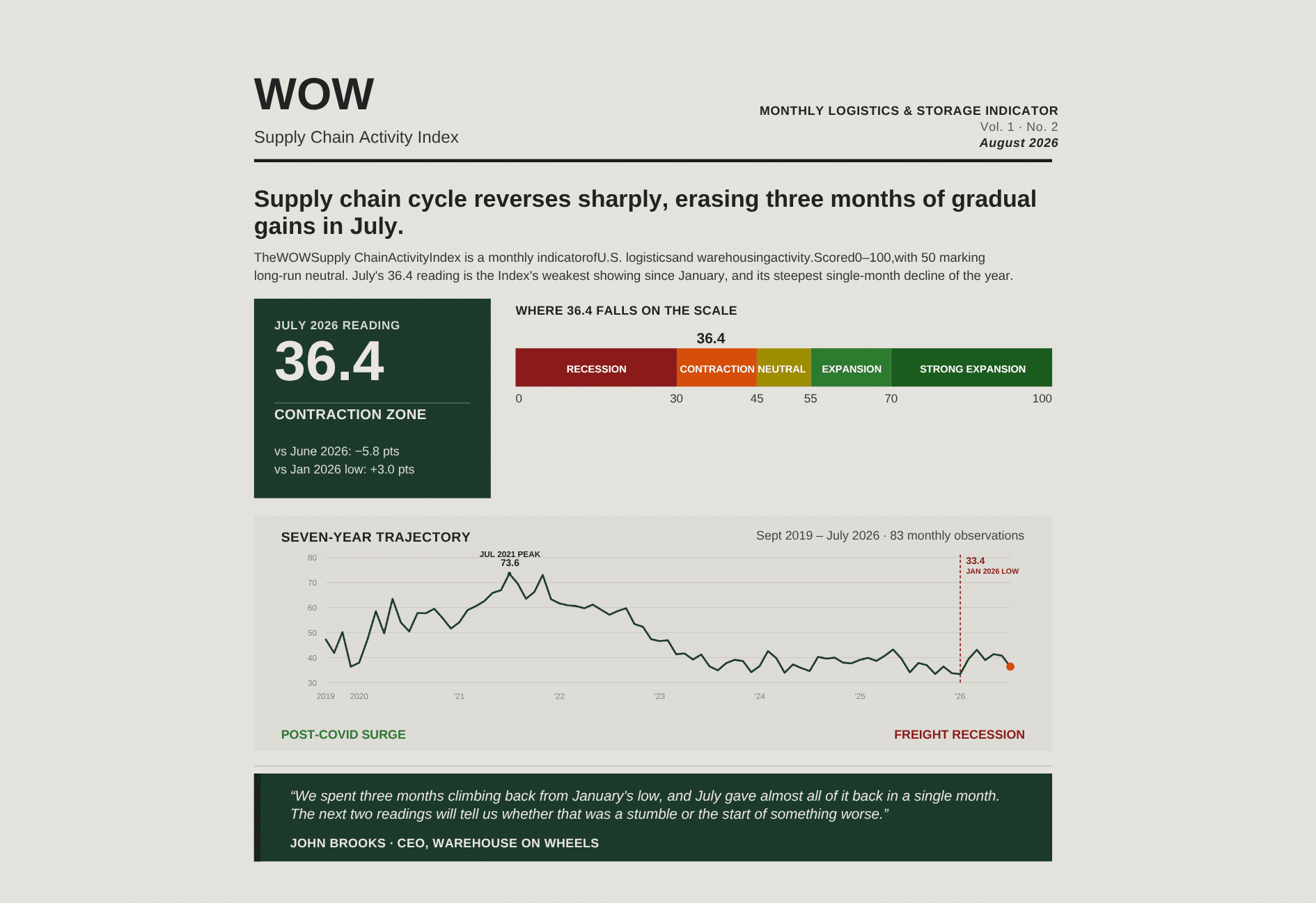
August 2026 Supply Chain Activity Index: 36.4, and the Spring Rebound Is Gone
If you are locking in Q4 capacity right now, you are making that call in a market that keeps changing its mind. It looked like it was recovering in March. It stumbled in April, steadied in May, slipped in June, and in July it fell hard enough to give back nearly everything gained since winter.
The August 2026 WOW Supply Chain Activity Index came in at 36.4, down 5.8 points from July's 42.2. That puts the market back within three points of its January cycle low of 33.4.
For anyone deciding whether to sign a warehouse lease, add fixed space, or hold off another quarter, that number is worth a few minutes.
The spring rebound has been erased
Look at how 2026 has gone. The index bottomed at 33.4 in January, climbed to a 43.1 peak in March, pulled back in April, partially recovered in May, dipped again in June, then fell sharply in July. Two pullbacks and one steep drop in seven months, and July alone wiped out nearly all of the ground gained since January.
"We spent the spring climbing back from January's low, and July gave almost all of it back in a single month," said John Brooks, CEO of Warehouse on Wheels. "This kind of reversal is a reminder that the market has not yet found a stable footing. We're still seeing conditions that favor shippers and challenge capacity providers, and the next two readings will tell us whether July was a temporary stumble or the start of something worse."
The pattern matters as much as the number. A market that climbs, stalls, climbs again, and then drops has not established sustained momentum. It has been moving unevenly all year, and the recovery still looks fragile.

What a 36.4 on the Supply Chain Activity Index means
A reading between 30 and 45 sits in the Contraction zone. July's 36.4 lands squarely inside it, and it points to a slowdown in the physical movement of goods rather than simply looser capacity. Goods are moving more slowly through the system, not just moving through more available space.
The index itself is a monthly composite gauge of U.S. supply chain activity, scored from 0 to 100. It is compiled from nine weighted data series, including WOW's own Deployment Ratio, LMI Warehousing Utilization and Transportation Prices, the Cass Freight Index for shipments, and broader manufacturing and industrial indicators. It reflects supply and demand balance across the U.S. supply chain and WOW's network of more than 6,000 customers.
What a reading below 45 means for shippers
Any reading below 45 points to conditions that favor shippers over capacity providers: softer demand, more available capacity, and downward pressure on pricing. If you buy transportation and storage, you have room to negotiate right now.
The catch is duration. Nobody knows how long this window stays open, and the last seven months have shown how quickly the picture changes. Committing to a multi-year warehouse lease during a soft stretch means paying for that space through whatever comes next, whether the market tightens in November or stays flat into 2027. Fixed space is a bet that your volume looks the same in three years as it does today.
That is why flexible capacity earns its keep in a market like this one. A storage trailer at your dock or in your yard can be added when volume shows up and returned when it does not, without a long-term commitment attached to it.
What to watch next
With the index back near its January low, the next several readings will tell the story. Two consecutive climbs would suggest July was a single bad month inside a slow recovery. Another decline would mark the start of a deeper slide across the logistics and warehousing market.
Either way, the practical move for the rest of 2026 is to keep your capacity decisions reversible. Plan for the volume you can see, and give yourself a way to add space quickly if Q4 surprises you.
Stay ahead of the next shift. Subscribe to the WOW Supply Chain Activity Index to get the latest reading and market insights delivered each month.
Talk to us about your Q4 plan
Warehouse on Wheels operates 37 locations across the United States, Canada, and Mexico, with local teams who know your market and dock-height trailers ready to deliver. If you are working out how much space you will need this quarter and how long you want to be on the hook for it, give us a call or request a quote. We will tell you what we have available near you and what it costs. No fuss, no delays, just answers.

Preparing for Q4 Demand & Seasonal Inventory
Where Does Your Holiday Inventory Go Before Peak Season?
Q4 really doesn't sneak up on anyone. You know it's coming, the freight is already booked and the calendar hasn't changed. What catches operations teams off guard is the gap between when inventory arrives and when the space to hold it was actually secured. Here's how to close it before that gap becomes a problem.
Why Warehouses Run Out of Space Before Peak Season Even Starts
The math on peak season logistics is straightforward: more product comes in and less goes out. But what looks like a warehouse problem in October usually started with a planning gap in August.
A few things accelerate the crunch:
- Inbound freight arrives ahead of schedule, and there's no buffer for early shipments.
- Packaging materials, corrugated, and supplies pile up before production even starts.
- Returns from prior seasons are still occupying floor space, so new arrivals turn into inventory overflow the day they land.
- Carriers and port delays push containers all at once, turning a manageable volume into a flood.
When warehouse capacity planning waits until the floor is already full, the options get expensive fast. Rushed warehouse leases, off-site storage with poor access or detention and demurrage fees that pile up while containers wait for a place to go.
The Cost of Waiting
A regional warehouse partner was staring down container delays at two locations, with detention charges running past $10,000 a day. They needed overflow warehouse space and they needed it immediately. They called Warehouse on Wheels, temporary storage capacity went in at both sites, and the detention charges stopped.
That’s a good outcome, but it could have been great. It was more expensive than it had to be, because the meter was already running before anyone made the call. Most Q4 scrambles trace back to the same thing: companies start planning too late, despite knowing Q4 is coming at the same time every year.
Warehouse capacity planning for Q4 should start in the summer, not October. By the time holiday inventory storage becomes a floor-level problem, the options for managing it have already narrowed.
How Businesses Create Capacity Before the Crunch
Warehouse on Wheels delivers 53-foot dry van storage trailers directly to your facility, distribution center, or job site. They arrive dock high and ready to load, and they're on month-to-month terms with no long-term commitment.
Here's how businesses use them to prepare for Q4:
- Inventory staging before peak season hits, so the warehouse floor stays clear for active pick-and-pack operations.
- Holding packaging materials, corrugated, and supplies off the production floor until they're needed.
- Creating a buffer for early inbound freight, so containers unload on schedule and demurrage fees don't get a chance to add up.
- Expanding capacity across multiple locations simultaneously, without reconfiguring a single facility.
A home-improvement chain kept its stores fully stocked through seasonal demand by flexing up storage trailers across multiple regions, then returning them after the season. Month-to-month terms meant that seasonal inventory storage scaled back down as cleanly as it scaled up.
What the Timeline Actually Looks Like
The businesses that handle Q4 without a scramble tend to follow a similar approach. They identify the supply chain capacity gap before it exists, secure temporary warehouse storage before freight starts moving, and stage inventory with room to receive more.
What a practical planning window looks like:
- August: Audit current warehouse capacity against projected Q4 inbound volume. Identify the gap.
- Early September: Contact Warehouse on Wheels to confirm storage trailer availability and schedule delivery. Most customers go from first call to storage trailer delivery within 24 to 48 hours, but locking in early gives you more flexibility.
- Mid-September: Storage trailers are on-site. Packaging materials, early inbound freight, and overflow inventory move into storage trailers. Your warehouse floor stays clear for operations.
- October through December: Flex up or down as volume changes. Storage trailers return when the season wraps, on your schedule.
That's the planning window that keeps Q4 from becoming a scramble.
The Numbers Behind the Decision
When teams compare warehouse overflow solutions, the decision usually comes down to cost. Temporary storage trailers are up to four times cheaper per square foot than fixed warehouse space. For most Q4 operations, the cost of a few months of storage trailer rental is covered many times over by the demurrage fees, labor inefficiency, and emergency warehouse costs they prevent.
Warehouse on Wheels serves 6,000+ customers across manufacturing, retail, and distribution. The aggregate savings across that customer base runs between $80 million and $100 million per year. That figure comes almost entirely from businesses that decided to plan ahead.
One Call Gets It Started
Warehouse on Wheels has 40+ locations across the U.S., Canada, and Mexico, with tens of thousands of storage trailers ready to deploy. When you're ready to start planning for Q4, call your local Warehouse on Wheels team or request a quote online. You'll get availability and pricing within hours, and storage trailers on-site before the season gets ahead of you.
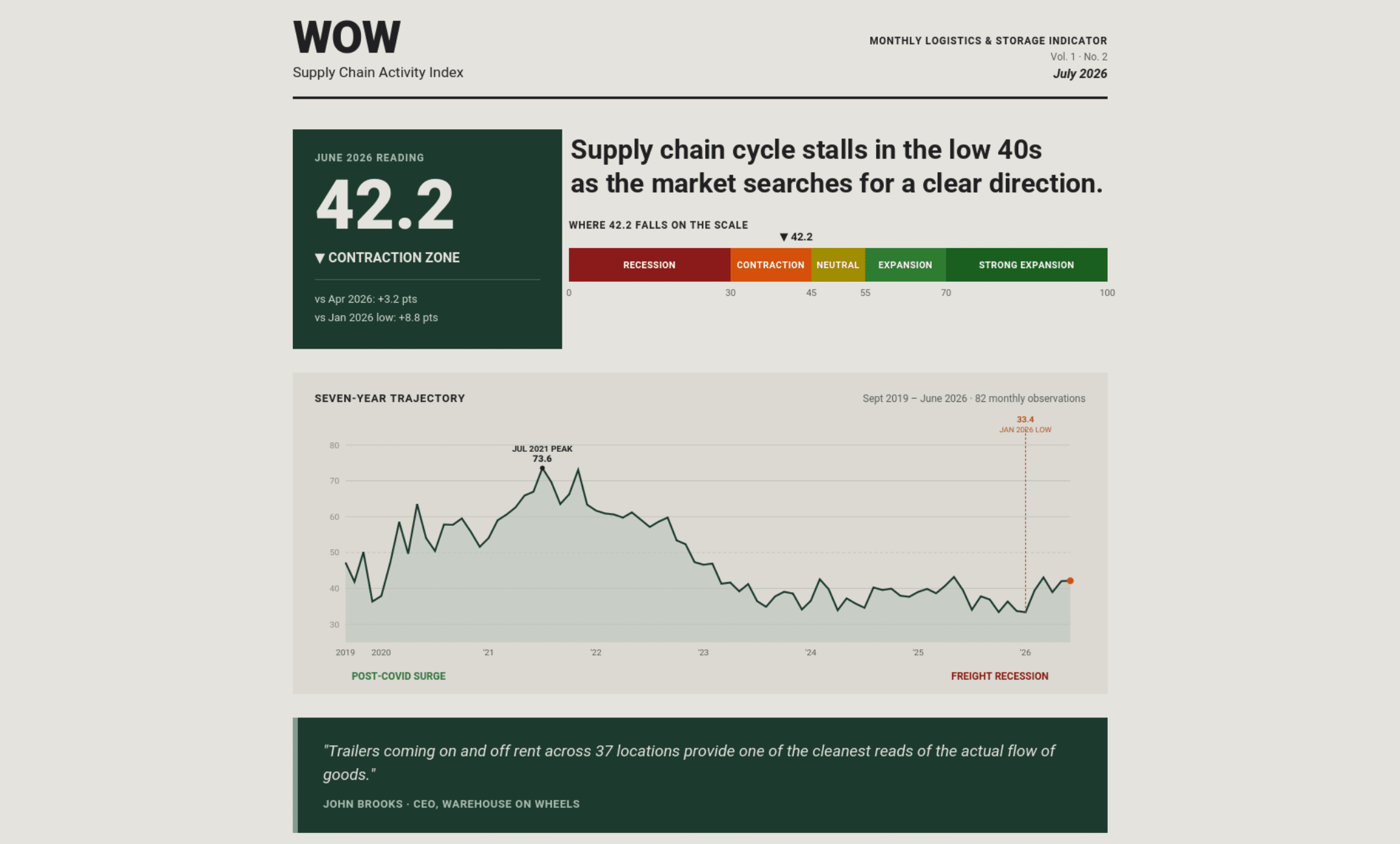
WOW Supply Chain Activity Index, July 2026: The Slide Has Stopped, the Breakout Hasn't
Freight rates are soft. Warehouse space is easy to find. Shippers are quoting everything twice and committing to nothing. If you plan capacity for a living, you already know what kind of market this is. The question is whether it's finally changing.
The July 2026 WOW Supply Chain Activity Index, based on June activity, came in at 42.2. That's still contraction territory, but it's the second straight month in the low 40s and nearly nine points above January's cycle low. The slide has stopped. The breakout hasn't come.

What a 42.2 reading means
The WOW Index scores U.S. logistics and warehousing activity from 0 to 100, with 50 marking long-run neutral. Anything below 45 sits in the Contraction zone, and June's 42.2 lands squarely inside it.
In practical terms, a low-40s market looks like this: lower freight rates, ample warehouse capacity, and limited pricing power across the trucking and storage sectors. Every one of those conditions works against capacity providers and in favor of shippers. If you're buying transportation or storage right now, the market is on your side.
A choppy climb off the January low
The index bottomed at 33.4 in January 2026, a seven-year low. The climb since has been anything but clean: 39.5 in February, 43.1 in March, a pullback to 39.0 in April, then 42.1 in May and 42.2 in June.
That path tells you two things. First, the deepest phase of the downturn may be ending. June's reading sits 8.8 points above the January low and 3.2 points above April. Second, the market still hasn't found sustained momentum. Two consecutive months in the low 40s is the most stable stretch since the downturn began, and the August release will show whether the market can finally push through toward Neutral.
The seven-year view
The index covers 82 monthly observations going back to September 2019, so the current reading comes with context. The cycle peak of 73.6 came in July 2021, at the height of the post-COVID restocking surge, when capacity was scarce and rates ran hot. The long descent that followed is the freight recession carriers and warehouse operators have been living through since. Against that history, a stall in the low 40s reads less like fresh weakness and more like a market that has stopped falling and started searching for direction.
What this means for your operation
A contraction-zone market rewards flexibility. Rates and capacity favor the buyer today, but nobody can tell you what Q4 looks like yet. Signing a multi-year warehouse lease to cover an inventory position you might not hold in six months is the expensive way to manage that uncertainty.
“Trailers coming on and off rent across 37 locations provide one of the cleanest reads of the actual flow of goods.”
JOHN BROOKS · CEO, WAREHOUSE ON WHEELS
We watch this cycle from an unusual seat, and that same on-and-off-rent pattern is how our 6,000+ customers handle a market like this one: they add storage trailers at the dock when freight builds and hand them back when it doesn't, with no long-term commitment either way.
How the WOW Supply Chain Activity Index is built
The index combines nine components, weighted to 100. Our proprietary WOW Deployment Ratio carries the largest weight at 20 percent. The other eight are public benchmarks the industry already trusts, at 10 percent each: LMI Warehousing Utilization, LMI Transportation Prices, the Cass Freight Index (Shipments), ISM Manufacturing PMI, ISM Supplier Deliveries, the manufacturers' inventories-to-sales ratio, the NY Fed Global Supply Chain Pressure Index, and the U.S. industrial vacancy rate (inverted). Methodology and full historical readings are available on request.
The next reading
The August index will answer the question July left open: can the market push through toward Neutral, or is the low-40s plateau the near-term normal?
Get each month's reading as soon as it's released. Subscribe to the WOW Supply Chain Activity Index newsletter and we'll put the number, the chart, and the takeaways in your inbox every month.