
WOW Supply Chain Activity Index, July 2026: The Slide Has Stopped, the Breakout Hasn’t
Freight rates are soft. Warehouse space is easy to find. Shippers are quoting everything twice and committing to nothing. If you plan capacity for a living, you already know what kind of market this is. The question is whether it’s finally changing.
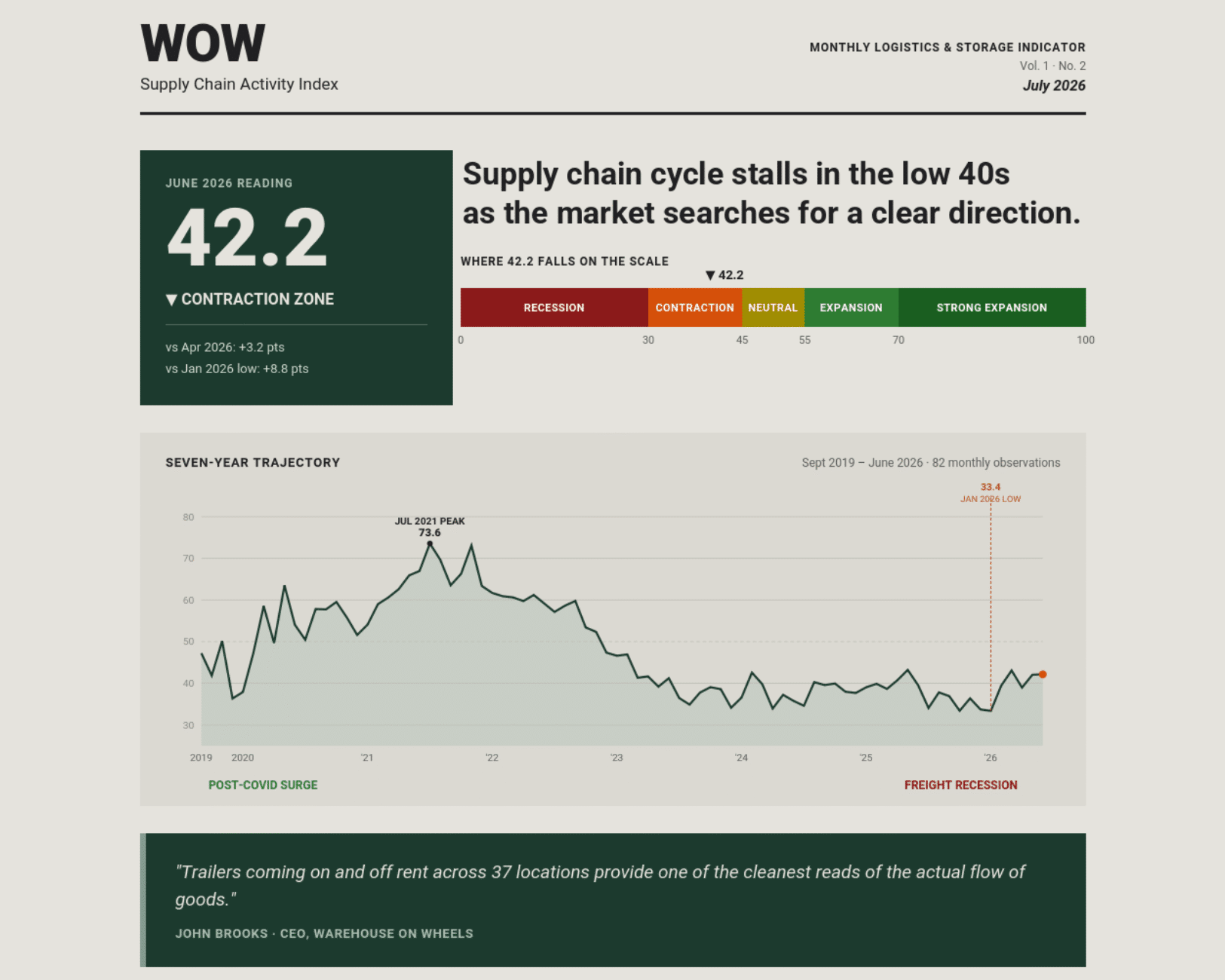
The July 2026 WOW Supply Chain Activity Index, based on June activity, came in at 42.2. That’s still contraction territory, but it’s the second straight month in the low 40s and nearly nine points above January’s cycle low. The slide has stopped. The breakout hasn’t come.

What a 42.2 reading means
The WOW Index scores U.S. logistics and warehousing activity from 0 to 100, with 50 marking long-run neutral. Anything below 45 sits in the Contraction zone, and June’s 42.2 lands squarely inside it.
In practical terms, a low-40s market looks like this: lower freight rates, ample warehouse capacity, and limited pricing power across the trucking and storage sectors. Every one of those conditions works against capacity providers and in favor of shippers. If you’re buying transportation or storage right now, the market is on your side.
A choppy climb off the January low
The index bottomed at 33.4 in January 2026, a seven-year low. The climb since has been anything but clean: 39.5 in February, 43.1 in March, a pullback to 39.0 in April, then 42.1 in May and 42.2 in June.
That path tells you two things. First, the deepest phase of the downturn may be ending. June’s reading sits 8.8 points above the January low and 3.2 points above April. Second, the market still hasn’t found sustained momentum. Two consecutive months in the low 40s is the most stable stretch since the downturn began, and the August release will show whether the market can finally push through toward Neutral.
The seven-year view
The index covers 82 monthly observations going back to September 2019, so the current reading comes with context. The cycle peak of 73.6 came in July 2021, at the height of the post-COVID restocking surge, when capacity was scarce and rates ran hot. The long descent that followed is the freight recession carriers and warehouse operators have been living through since. Against that history, a stall in the low 40s reads less like fresh weakness and more like a market that has stopped falling and started searching for direction.
What this means for your operation
A contraction-zone market rewards flexibility. Rates and capacity favor the buyer today, but nobody can tell you what Q4 looks like yet. Signing a multi-year warehouse lease to cover an inventory position you might not hold in six months is the expensive way to manage that uncertainty.
“Trailers coming on and off rent across 37 locations provide one of the cleanest reads of the actual flow of goods.”
JOHN BROOKS · CEO, WAREHOUSE ON WHEELS
We watch this cycle from an unusual seat, and that same on-and-off-rent pattern is how our 6,000+ customers handle a market like this one: they add storage trailers at the dock when freight builds and hand them back when it doesn’t, with no long-term commitment either way.
How the WOW Supply Chain Activity Index is built
The index combines nine components, weighted to 100. Our proprietary WOW Deployment Ratio carries the largest weight at 20 percent. The other eight are public benchmarks the industry already trusts, at 10 percent each: LMI Warehousing Utilization, LMI Transportation Prices, the Cass Freight Index (Shipments), ISM Manufacturing PMI, ISM Supplier Deliveries, the manufacturers’ inventories-to-sales ratio, the NY Fed Global Supply Chain Pressure Index, and the U.S. industrial vacancy rate (inverted). Methodology and full historical readings are available on request.
The next reading
The August index will answer the question July left open: can the market push through toward Neutral, or is the low-40s plateau the near-term normal?
Get each month’s reading as soon as it’s released. Subscribe to the WOW Supply Chain Activity Index newsletter and we’ll put the number, the chart, and the takeaways in your inbox every month.