Meet the CEO Who Was a Customer First
In the premiere episode, host Mark Mann sits down with WOW CEO John Brooks to talk about the story behind Warehouse on Wheels, the math that makes mobile storage up to 4X less expensive than warehouse leasing, and the decentralized model of local market CEOs running 37 locations across the US, Canada, and Mexico. John explains why he calls WOW “elastic warehousing,” shares emergency response stories from the field, and lays out his vision for growing the company to 100 locations and 100,000 trailers.
Key Takeaways
- The story behind WOW starts with a customer in pain. Before founding the company, John was renting 150 storage trailers to handle overflow at his own facility. Containers were arriving with nowhere to put them, and detention fees were stacking up. That firsthand experience is what shaped WOW into a business built around the friction it solves.
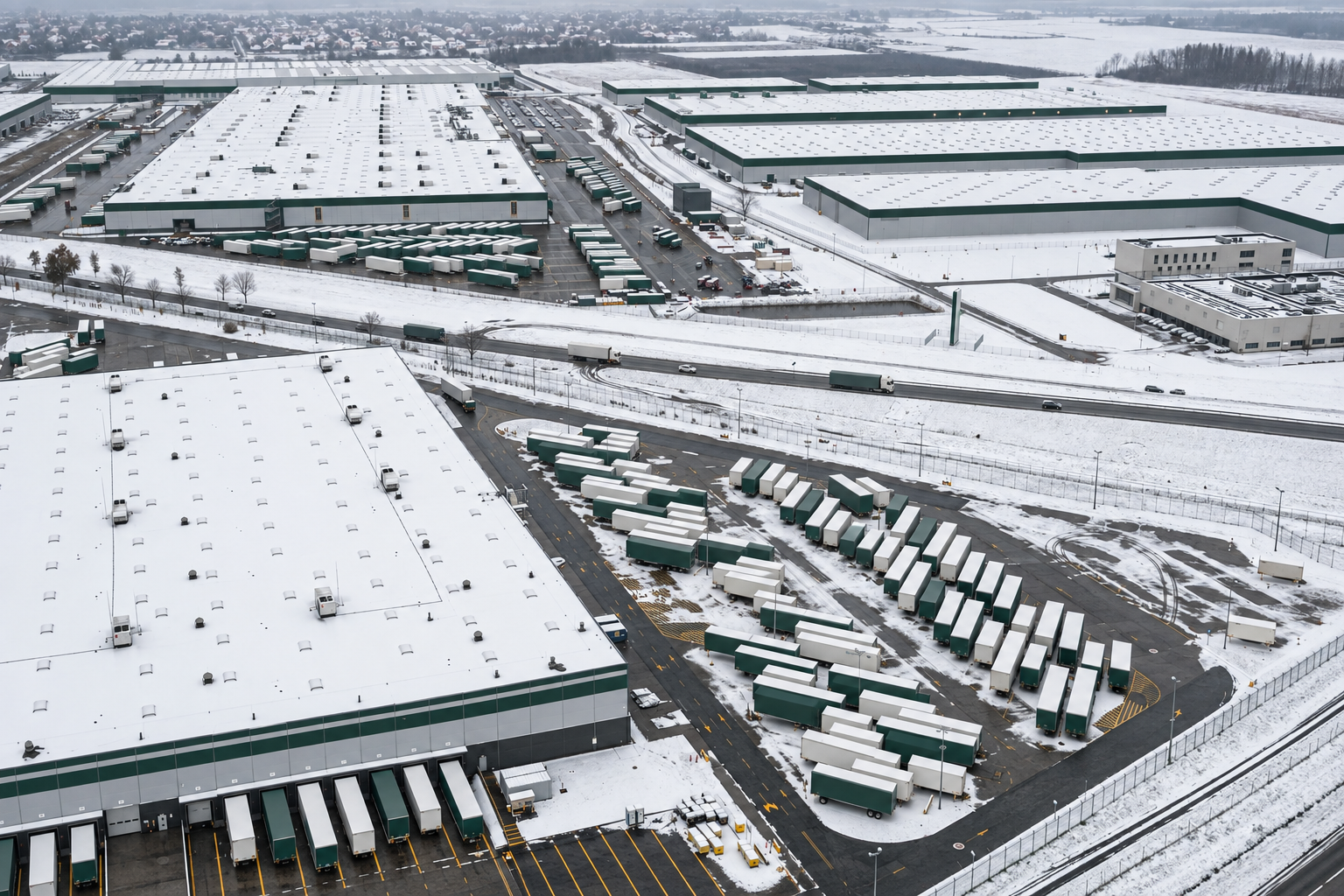
- Elastic warehousing is more than parking lot storage. One plastics manufacturer scales between 300 and 900 trailers to match production cycles for a major quick-service restaurant chain. The trailers segregate inventory by product run, store finished goods 300 yards from the facility, and turn over as the QSR’s printed cup orders shift each quarter. That’s flexible industrial storage doing real work in the supply chain — not a band-aid.
- The financial case is straightforward. Mobile storage runs up to 4X less expensive than traditional warehouse leasing on a per-square-foot basis. Pair that with 30-day evergreen contracts (versus 5, 7, or 10-year leases) and EcoVadis certification, and the math wins hearts and minds across finance and procurement.
- Local market CEOs are the engine. WOW’s general managers run their locations like entrepreneurs, with discrete P&Ls and equity-like incentives. When a customer’s facility blew a hole in the wall after a production line explosion, those local owners are the reason trailers were rolling within hours to keep their inbound goods moving.
- Plan ahead, don’t just react. Most customers come to WOW with their hair on fire. John’s playbook for 2026 is to flip that script: get on speed dial, set up a contingency model with idle trailers parked at a lower rate, and treat mobile storage as a strategic capacity layer — not a last-minute scramble.
Episode Chapters
Click any timestamp to jump to that section on YouTube.
- 00:00 — Welcome to The Wow Factor
- 00:22 — Meet John Brooks
- 03:16 — Supply chain challenges
- 05:24 — Elastic warehousing concept
- 07:34 — Handling crisis
- 09:50 — Organizational structure
- 10:05 — Field visits
- 11:46 — Exemplary general managers
- 13:47 — Cost efficiency
- 14:55 — Addressing customer concerns
- 16:50 — Future supply chain strategies
- 19:14 — John Brooks: the man behind the business
- 21:30 — Lessons from mentors
- 23:28 — Open communication in the company
- 24:58 — Personal life and hobbies
- 26:16 — Dispelling myths about the trailer rental business
- 27:06 — Turning the mic on the host
- 27:28 — Goals for the podcast
- 30:31 — Strategic space solutions and micro-learning
- 31:16 — Sports analogy for Warehouse on Wheels
- 33:04 — Mark’s multifaceted role at Warehouse on Wheels
- 33:40 — The movie analogy
- 33:54 — White House internship
- 36:12 — Closing remarks
Transcript
[00:00] Welcome to The Wow Factor
Mark Mann: Welcome to the premiere episode of The Wow Factor. I’m your host, Mark Mann. My guest today is the man who built the Warehouse on Wheels family of companies. He is the CEO of Warehouse on Wheels, Jonathan Brooks. John, welcome to The Wow Factor.
[00:22] Meet John Brooks
John Brooks: Thanks, Dr. Mann. I really appreciate it. Super excited to kick off this project. I’m the not-so-pretty window dressing to get all this started. I think the heart of this thing will be the discussions you have with our team members, our general managers, who I call our local market CEOs, and just hear the stories about how day in and day out they’re solving supply chain issues for our customers. I think that’s what’s really been the jet fuel to help us achieve this dramatic growth, and I’m just really proud to be here. So, thank you for that.
Mark Mann: Absolutely. So for the folks listening, what’s the one thing you want them to take away from this conversation today?
John Brooks: I think I’d like for them to understand the solution itself. Because oftentimes it kind of gets lost in the shuffle of the day-to-day and fighting the fires on the front line. And then really understand the story behind WOW — that it is a group of dedicated professionals that show up every day ready to go to work, just like our trailers, and it’s a group that you’ll want to partner with.
Mark Mann: Absolutely. Great message. Now, you have a very unique background. You didn’t start driving a truck or working on a dock. You have a heavy background in finance and private equity, working as a CFO for some big industrial companies. How did a finance guy find his way into this gritty world of storage and cartage and yards and trailers?
John Brooks: Yeah, that’s a great question, Mark. While I was in my finance phase, we’ll call it, at Arthur Andersen, I was rearranging the deck chairs on the Titanic as that thing went down. Never worked on Enron, never shredded a document. But I really always prided myself on folks saying, “You’re not a typical accountant,” because I really enjoyed the operating side of my clients and understanding their businesses and being on the shop floor.
As I was dealing with the Andersen collapse, I was actually working on my MBA at Notre Dame. I oftentimes tell people Notre Dame didn’t want me as an undergrad because I wasn’t smart enough, but they took my money as a grad student. So God bless them. But that experience — the Andersen collapse, working on my MBA — really made me look at the broader spectrum of business and what was out there. And so it started me on a path of CFO roles that all eventually morphed to COO roles.
I really found the concept for Warehouse on Wheels because I was a client. I was renting 150 storage trailers because our warehouse was overflowing. Containers were arriving and we didn’t have anywhere to put them. We were paying detention fees, and it was the optimal solution to deal with that pain point. So the story of WOW is rooted in the fact that I was a customer.
[03:16] Supply chain challenges
Mark Mann: That’s great. That background gives you a unique perspective not only on the financial side but, like you said, on the operations side as well. Let’s switch gears and talk about the problems that Warehouse on Wheels exists to solve. When you look across the US, Mexico, and Canada — all the footprints that we exist in right now — what are the three biggest space headaches that you see your customers facing, regardless of the region?
John Brooks: Today, you can’t open a business periodical without seeing some discussion of tariffs. Coming off the heels of the COVID supply chain disruption, and then when you marry that with the fact that every individual company has its own supply chain issues — did a part break? Did a supplier fall behind schedule? Whatever the case might be. Definitely the headlines drive a lot of the attention, but for us, because we serve 7,000 customers across our 37 locations and using our 37,000 assets, it is a unique story in every situation. But the one thing that always holds true is, when that does happen and they make that phone call, we show up ready to go to work.
Mark Mann: And that’s that friction I’ve heard you talk about in the past — friction in the supply chain, right?
John Brooks: Yeah, absolutely. That friction can be any number of sources. It can be geopolitical. It can be weather-related. Or just simply executing the operational cadence of a business. I think it’s pretty amazing that one of our customers — a Fortune 100 automotive manufacturer — has relied on us for over two decades to provide trailers just in case there’s a disruption in their just-in-time manufacturing process. So a company that’s recognized worldwide as the leader in manufacturing processes — something we all studied in school and others try to replicate day in and day out — they’ve identified and agreed that the solution we provide is optimal within that supply chain. I think that’s a real badge of honor that we wear.
[05:24] Elastic warehousing concept
Mark Mann: Yeah, it’s a long-term strategy. So let’s shift from that band-aid thinking to a conversation about strategy. I know that strategic thinking is a big topic for you. You’ve used the term “elastic warehousing” to describe what we do. I’ve also heard you talk about flexible industrial storage. A lot of the industry sees trailer and container storage as a parking lot or a band-aid. When you say elastic warehousing, what does that mean, and how does it change the way a customer should think about Warehouse on Wheels?
John Brooks: Excellent point. For me, I think it’s rooted in an example of one of our customers. We have a plastics manufacturer that currently produces the majority of the drinking cups for a very large quick-service restaurant chain. We would all know and see them on the right corner of every intersection — I think how they build their buildings.
In that instance, that plastics manufacturer for about the last 25 years has relied upon us to provide that flexible industrial storage so that they can optimize their throughput from raw material purchase through production of blank drinking cups, which then gets stored on our trailers and parked 300 yards from the facility. Then when that quick-service restaurant chain calls and says, “Hey, we want a third of those with this printed on it for this quarter,” they back up those trailers, they print those cups, they reload them on our trailers, storing them 300 yards from the facility. And then when the 3PL for that restaurant shows up, they cross-dock the finished goods and it’s off to that customer.
I think that’s a great example because that customer may at some point have 900 trailers. Business is slower, they may pull back to 300 trailers. That flexible solution — again, something that they’ve been doing for multiple decades — is another testament, another, if you will, “good housekeeping seal of approval” on the optimal nature of the solution we provide.
[07:34] Handling crisis
Mark Mann: Yeah. And there’s a lot of pressure out there. You talked about the COVID years. You talked about tariffs. There’s a lot of talk about tariffs right now and there’s a lot of pressure in the industry. You’ve led this company through some pretty wild economic swings. Tell me about a panic moment you remember — maybe during the post-COVID supply chain crunch — where our team really had to step in and save the day.
John Brooks: Yeah, we actually had a customer, they recycle empty printer cartridges. Their business is harvesting the residual inks, the precious metals that are involved, the plastics — and that’s a pretty volatile process. They had fired up a new production line and were processing materials, and literally had an explosion at their facility. Blew a hole in the wall. And at a couple hours’ notice, we were rolling trailers to the facility to hold the inbound goods, the input to their manufacturing process.
While it wasn’t tied to a specific geopolitical event or something of that nature, that’s the sort of responsiveness you can count on. That’s why, when I built the company, I really felt it was essential to have these local market CEOs — our general managers who run these markets as true entrepreneurs, who own that discrete P&L, who are incentivized along their location’s performance, and then also having equity or equity-like positions in the business. So they’re truly owners.
Mark Mann: Yeah. That customer you described — after 48 hours of WOW coming in, showing up, and saving the day, what would you say changed for that customer by accepting the solution that we offer?
John Brooks: Mark, I think it’s just really about putting our money where our mouth is. We talk a lot — and those that have had to listen to me pontificate on LinkedIn or wherever have heard me talk about the Ritz Carlton service at the Hampton Inn price. Really, when you peel that back and you talk about Ritz Carlton service, it’s that white glove, that customer intimate, that engaged in your business to the point where I truly understand what your issues are and the challenges that you’re facing.
So I think when we can tell stories like that, when we can share real-life experiences, it just really solidifies for folks that it’s not lip service. That’s how we’re showing up every day. And that’s critical, I think, in our success and our ability to scale the business, and something that will be extremely important to me throughout my time here leading this organization.
[10:05] Field visits
Mark Mann: It really is a very decentralized organization. Of course, you’re the CEO, but you do talk a lot about simplicity. You talk a lot about execution at the field level, at the local CEO level. When you visit our branches, what do you look for? Who is the hero of that story in your eyes? Is it the dispatcher, or the mechanic, or the driver? Who is it?
John Brooks: As I think about that question, I kind of reflect on one of my favorite TV shows, The Office. There’s a poster behind me here. I was actually on the set of The Office years ago when they were filming an episode, and the cast was so nice and gracious with their time. Got to meet everybody. Got to sit at Michael’s desk, at Jim’s, at Dwight’s, at Pam’s. I sat there at the phone.
But why I bring that to light here is because that’s such an ensemble. So your question about who’s the hero — think about The Office. Yes, Michael’s the star. Steve Carell was the lead. But that show wouldn’t have been anything without Dwight, Pam, Jim — hell, even Creed, you know, and his one-liners every two or three episodes.
I think of our locations a lot like that. It’s an ensemble. And it just jazzes me up every time I’m there, just seeing the hum of that operation, how everybody’s in sync. I really get that pulse also when we do our semiannual engagement surveys and get the open-ended responses from people that talk about what WOW means to them. I spend a ton of time in those comments and really try to internalize them, understand them, make sure we’re being responsive to them, that they align with our principles, that I’m on message — all that good stuff. But yeah, when I get to the sites, I think of more of it from an ensemble standpoint.
[11:46] Exemplary general managers
Mark Mann: We’re going to meet a lot of those heroes as we continue this little podcast journey. Do you have a story of a particular GM who embodies the spirit of making the customer’s life easier?
John Brooks: Yeah. I mean, I’ve got to be careful. It’s like my kids — you know, I love all my kids. Some days I love one more than the other. And it’s that way with the GMs, because I kind of view them in that same way. And quite honestly, sometimes —
Mark Mann: Don’t be afraid to name names, because I’ll be interviewing them and I’ll be sure to tell them, “Hey, John brought you up on the podcast.”
John Brooks: Well, sometimes I have to lean into them like the kids — like, it’s time to pick your toys up, it’s time to clean up the yard, all that good stuff. So it’s a real, real-life example. But I would tell you, some of the guys that I’m the most proud of are the guys that have grown into bigger roles as WOW has scaled.
I start with Brent Meadors, our Chief Operating Officer and the President of our US operations. I recruited Brent to be the General Manager of Evansville. We were going through some changes as we really started building this business. And I found a guy — lucky enough for me — that lived in Michigan, but his deal with his wife, I think, was the only way she was ever moving is if she moved back to Evansville. And I was like, “Wow.” Okay. Well, that’s the good Lord, that’s divine intervention right then and there. And then it proved that he was just an absolute superstar. So he set the mark for all the others that followed. He’s the case study, and now he’s of course our Chief Operating Officer and doing an amazing job.
I get to do the things I do, like this, because I have guys like Brent on the front line. So I would point to him as probably the best example. Now, there are other guys — you’re going to have them all on here — and they’re on the team for a reason. They have a superpower that adds value and aligns with what we want to do. That’s why I’m also excited about this program and what we’re going to show to the world, because we’re going to let everybody see how powerful the engine is.
[13:47] Cost efficiency
Mark Mann: Yeah, absolutely. So let’s put your CFO hat back on for a minute, because I want potential customers and anybody watching the podcast to know — if you’re a GM trying to convince a customer’s CFO to rent 50 trailers instead of leasing warehouse space, what’s the math equation? How should you talk to them about that? What should you show them?
John Brooks: Yeah, I think it’s really pretty straightforward. Depending on the market you’re in, our solution is generally two to four times less expensive on a per-square-footage basis. Boom. Check the box: value. We only require a 30-day evergreen contract versus a 5, 7, or 10-year lease. Check the obligation part of it. We’re EcoVadis certified, so you get ESG credit for us. We’re more environmentally friendly than building that box or that warehouse you might otherwise occupy.
So I think those things all start to stack up. And then I think it goes further in the organization. You win hearts and minds with all of that. Plus, from a procurement standpoint, they can rely on us anywhere. We’re nationwide. We’re in Canada, the US, and Mexico. So we provide that one PO, that one-stop solution. I think there’s a very easy and compelling argument that wins the hearts and minds of CFOs and procurement officers pretty handily.
[14:55] Addressing customer concerns
Mark Mann: Yeah, I heard you say a minute ago, “Ritz Carlton service at a Hampton Inn price.” That really is a great model. How do you explain that ROI to a customer who just wants — “I just want the cheapest wood or metal box I can find”? There’s a lot of that out there.
John Brooks: Definitely. We oftentimes hear people say, “Well, why don’t I just buy the trailers?” Fair enough, if that’s what you want to do. But I would tell you that they come with a maintenance requirement. So do you have the infrastructure, whether that’s in-house or the relationships, in order to do that service, to give that federal certification on that trailer? Also, are you really going to need it six months from now, a year from now? It’s sort of the same argument you make with this idea of flexible or temporary warehouse space.
Just look at how business has evolved, even over the last 24 months — the rush to buy ahead and to have product here in advance of the tariffs. And as that subsides, had you signed up for a 5-year lease on some extra warehouse space that you might not otherwise need, then you’re locked into it.
So yeah, I think it’s really one of those things where, you know, there are options out there, definitely something for you to consider. But time and time again, if you come back to the numbers, if you look at the level of service we provide, the fact that we’re going to send you a safe, dark, and dry trailer that shows up ready to go to work, the fact that if a fork truck driver puts a blade through the side of it — they occasionally do — or they go in hot with a pallet and they rip out five roof bows (seen it happen) — we’re going to be there to fix it, to get it back in working order so it’s not interrupting the flow of your normal operation.
[16:50] Future supply chain strategies
Mark Mann: Yeah. So if you were to give our customers a playbook for 2026 — because 2024 and 2025 have been tough years for a lot of industries out there — if you were sitting with a logistics director or a manager at a warehouse who’s nervous about the economy next year, what’s the first step you would tell them to take to protect the supply chain, to protect their assets?
John Brooks: It’s a great question. It’s so unique to every given situation, but where we play a role, I guess, is where I can speak somewhat intelligently. And what I would tell you is: have us on speed dial, first and foremost. Let’s be an approved vendor. Let’s be ready to go to work.
But from there, I would say let’s look at those peaks and valleys and learn those lessons from the past. You know, history doesn’t always repeat itself, but it rhymes. I know you, as a professor, appreciate history can align with that. So if that’s the case, we have some unique solutions around contingency models. Let’s place some assets there at a much lower rate as they sit idle, but they’re there on demand, ready for you to draw upon them when you need them. They go active. They’re there to provide the solution.
That’s the kind of thing that you want to do. You want a contingency plan. You want to look back at trends and think about: okay, given this dynamic and where we sit today, the likely outcomes are closer to these two or three historical events that we’ve experienced. What have we had to do, and how have we had to react in those instances?
The great thing about our GMs is they are those boots on the ground. They have those conversations with their customers. This isn’t a transactional business for us. This is a partnership, because the great thing about what we do is nobody plans for it. You don’t sit here today and say, “Six months from now, I bet 50 containers are going to be here and I won’t have anywhere to put them. So what am I going to do?” No. Those 50 containers show up and you have a few days’ notice, and you need a partner that’s going to respond. That’s really what we’re about.
[19:14] John Brooks: the man behind the business
Mark Mann: Yeah, it’s strategic planning. It really is. We’ve got to get away from that band-aid mindset, like we talked about earlier. Let’s plan this out. Let’s look at trends. Absolutely agree with you. So let’s switch gears. We’re going to call this our signature round. We want to get to know John Brooks, the man.
You’ve mentioned that your kids are entering the adulting cycle now, which means they’re well on their way to building their own lives and careers. So looking back, what was the moment in your career when you thought, “Yeah, this is it. I’m cut out to be this entrepreneur, CEO. Warehouse on Wheels is where I need to land”?
John Brooks: I don’t know that I’ve had that moment, to be honest with you. That’s why I try to continue to stay active in my learning, and it keeps you humble. So yeah, that’s a great point of view and a great question.
I guess on the WOW side, being a customer and understanding unit economics and the business and how fragmented what we do is in North America — that was the aha moment for me. There’s absolutely a place for someone like us who is consolidating the space, is solely focused on storage and local cartage. We’re not the leasing guys. God bless them, they’re good at what they do. Keep doing it.
We have such a strong economic profile against our relative competitor — which is warehouse space — that it’s a business I’m very, very proud of, and I think it’s still got a lot of runway. My vision, as I’ve shared with you before, is: if we’re at 37 locations and 37,000 trailers today, I want to build this thing to 100 locations and 100,000 trailers. And I firmly believe we have the roadmap. We’ve executed the greenfield developments. We’ve built this business through 20-plus acquisitions that get integrated within the first 90 days, as you well know.
You’ve been the steward of our learning and development organization. So we’re training and empowering the next generation of leaders in this business. Thank you for that.
I just really am passionate about what we’re doing. I don’t have all the answers. I’ve been fired before, so I am far from perfect. But I’m trying to take all of those lessons, all of those examples — the good, the bad, and the ugly — and make sure that we hone in on the good, we don’t repeat the bad, and we sure as hell avoid the ugly.
[21:30] Lessons from mentors
Mark Mann: Yeah. So speaking of lessons, you mentioned learning from mentors and private equity partners in the past. What’s one piece of advice a mentor gave you that you now find yourself repeating to our team members?
John Brooks: That’s a great question, and my challenge as I think through that is there’s probably not this one quote or piece of advice. The thing that a few of my early mentors really poured into me was the need to improve my emotional intelligence. I showed up every day ready to go to work, just like our trailers, and would work hard, but sometimes it was probably the bull in the china shop.
So finding that emotional intelligence, that balance of aggressiveness and drive versus, you know, everybody coming along — not just running ahead and trying to find the solution. That’s really what I’m indebted to some of my earliest mentors and supervisors of. “Good job, kid. Pat on the head. Now, let’s figure out an easier way to do this.” I think that’s really what for me was kind of a light-bulb moment, and I try to share it with folks.
I’ve actually been active on LinkedIn a few times now. I put out a post that says, “Hey, here’s my background. If I can be helpful to any of you out there, and you want to talk for 10 or 15 minutes, here’s my schedule link. Let’s do it.” I feel an obligation to pay that forward, because I think I could have saved myself a tremendous amount of aggravation — and maybe a few firings, I don’t know. But at the end of the day, I would have been better served, and better serving the organizations I was with early on, if I had that better perspective on emotional intelligence.
[23:28] Open communication in the company
Mark Mann: Well, I can tell you we all appreciate everything that we learned from you. I know you’re very personable with all of us here, and I would guess that most everybody in the enterprise has your personal cell phone number, right?
John Brooks: Yeah, that’s something I started doing when we started building the company. When we onboard a new employee — now we’ve gotten to the point where we do this once a month — we bring them all together and chat on a video chat like this, or if I’m in the market talking with them. And at the end of that, I give everyone my personal cell phone number. Same one my wife, my children, and I say my mama call me on. I don’t have a burner, don’t have a work phone.
My point in doing that is I want people to feel comfortable to raise issues to me, because with 37 locations now, with 250-plus employees, I don’t know everything that’s going on every day. So I want them to have an avenue to come talk to me. Now, oftentimes when that happens, the first question I ask is: “Did you talk to your boss? How did that go? What happened? How was the resolution, or lack thereof?” Because I want to honor the chain of command. You’ve got to respect that. That’s the way we’re going to scale and operate. I can’t just override everything.
With that said, assuming they’ve had that conversation, assuming they haven’t gotten a satisfactory answer, that’s when I can step in and we can start to figure out what to do about that. Now, I tell them oftentimes, you may not get the answer you want from me, but I’m going to listen, and we’re going to try.
So that’s why that’s very, very important to me. Not a lot of folks take me up on it. There’s a few that, over time, have abused it, quite honestly — interesting phone calls — but nonetheless, everybody gets access, and everybody can call whenever they need to.
[24:58] Personal life and hobbies
Mark Mann: Yeah. So when you get home and shut it down for the night, what pulls you away from the business? How do you reset?
John Brooks: It’s interesting, because oftentimes I’m in meetings all day, having conversations like these and others. So I’m really looking for quiet and just peacefulness. My wife and I enjoy time together after work. I really refer to her a lot as my rock, my refuge. She doesn’t come from the business. She’s not worried about the trailer she sees running up and down the road and whose brand’s on it, all that good stuff. So we’re on to other things — about the kids and what’s going on with the family or our lives.
My veg-out time, right this time of year, is with football. So I very much enjoy this time of year. As I mentioned earlier, being a Notre Dame grad, that’s sort of my passion and what I care the most about — who wins and loses. But enjoy football.
My go-tos are reruns of The Office — we talked a little bit about that — or reruns of The Big Bang Theory. And it’s not even so much to watch it. It’s just noise in the background that’s predictable, and you know what you’ve got. So yeah, pretty low-key. Nothing exciting. I’m not jumping out of airplanes. I play a little bit of golf, but there’s not a lot to talk about there.
[26:16] Dispelling myths about the trailer rental business
Mark Mann: Well, John, this has been an excellent conversation. What’s one myth about the trailer rental business that you hope we can retire forever?
John Brooks: That it’s not the optimal solution when compared to traditional warehouse space. The numbers say it, hands down. There’s no disputing it. It’s not something we’re making up. It’s not a great claim like “we make the best pizza.” The numbers prove it. It’s been tried and tested for decades by some of the biggest, most well-respected operators in the world. Whether it’s a Fortune 100 global auto manufacturer, whether it’s the world’s largest e-commerce company — all of those folks have signed up for this solution and have embraced it consistently.
[27:06] Turning the mic on the host
John Brooks: So I think that’s a big part of it. But before we wrap up — nobody ever does this, but we’re going to turn the mic on the host. I have a couple of questions for you, my friend. And you know, I’m going to go org-chart on you, since that’s how it works. I’m going to ask you a couple of questions. As we start this podcast journey, I drafted you. I volunteer.
[27:28] Goals for the podcast
Mark Mann: Well, you know, my current role here is Learning and Development Director. I think the content we’re developing here — I guess my goal for The Wow Factor is not just to share company news and introduce you to folks who create moments of magic for our customers across North America, but really to build a unifying knowledge engine for the company. That includes three things.
First, I want to use this platform to unify, to pull us together as one WOW. I’ll be interviewing company leaders, but also general managers from each of our legacy brands, and I want to try to bridge that gap between decentralized local yards and the national Warehouse on Wheels identity. I want customers in St. Louis, Missouri, to hear a GM in Phoenix, Arizona, and realize we’re on the same team here. We’re solving the same problems. That makes a big company feel small and connected, and it’s very important.
Second, especially for our internal folks, for our associates, even for our vendors, for our global partners, is to preserve tribal knowledge. For example, in a few weeks, I’m going to be interviewing Chris Martin. He’s the GM in Louisville, Kentucky. He’s an old warhorse, and he’s got decades of experience in this industry. One of the things I plan to ask him is, you know, what a mentor taught him, and who was your mentor, how did they teach you and help you along the way? I really want our listeners to hear his war stories — because, well, first of all, that guy’s got some war stories to tell you, but just the experience of doing exactly what you said earlier, about coming alongside a company and partnering with them to offer the solutions they need as soon as they need it, like a call away.
I think that’s really important. And by doing that, we’re going to be capturing this tactical knowledge of our veterans, right? By recording these stories, we’re building a permanent library of how we do things here. New customers can learn from this podcast long after the episodes air.
[30:31] Strategic space solutions and micro-learning
Mark Mann: So I guess the last thing would be — I really want to shift the mindset of those in this industry from transactional to strategic. We talked a little bit about that earlier. Get away from the band-aid, right? Our folks are well aware that most of our customers come to us with their hair on fire. Something has changed, something has happened. They need 50 trailers today by close of business to solve the problem. I want people to get away from that band-aid thinking and really start planning. I want them to think in terms of strategic space solutions. And I think this platform is good for that.
So we aren’t just teaching them what you rent — which is trailers — we’re teaching them how to sell the value of flexible storage solutions. The college professor in me also really hopes that we’re creating a kind of weekly micro-learning module disguised as a talk show. So that’s kind of what I want to get out of it.
[31:16] Sports analogy for Warehouse on Wheels
John Brooks: That’s awesome, Mark. That’s awesome. So here are a couple of off-the-wall questions. If you had to describe WOW using a sports analogy, what would you choose, and why?
Mark Mann: Oh, that’s a great question. Given my deep love for the Cincinnati Reds — you know, I’m an old Ohio guy, baseball in general, but especially the Cincinnati Reds — and my background in organizational development and the specific mission of WOW, that local intimacy backed by national power, baseball is probably the best analogy that fits.
I would say that Warehouse on Wheels is not the starting pitcher. We are the elite bullpen. You can think of our customers as the starting pitcher. They handle the game just fine. They throw strikes. They manage the inventory. They get through the first six innings of the year without an issue.
Then comes the seventh-inning jam, right? The crisis. Maybe it’s peak season. The cleanup hitter’s coming up. Maybe a manufacturing machine breaks down — there’s an error in the infield, or something. Or maybe they grew too fast and the warehouse is exhausted — there’s a high pitch count on the starter. The bases are loaded with inventory. The manager is pacing the dugout. We are the call to the bullpen.
This is where WOW comes in. We’re the long reliever. We’re the specialist. We’re the closer when it’s a total emergency. You know, that whole “we need 50 trailers by tomorrow morning or the line shuts down.” We come in, we throw gas, 100 mph heat. We get the save, and the customer —
[33:04] Mark’s multifaceted role at Warehouse on Wheels
John Brooks: I love it, man. I’m ready to run through the wall, dude. That’s freaking awesome. Thank you so much for doing that. So this clearly is going to show how terrible of an interviewer I am, because this should have been the first question.
We’ve talked about the fact that you lead our learning and development organization. What people don’t know is we originally hired you to head up our environmental health and safety, which you took on full-bore and did an amazing job with, and have built an amazing organization that you now have some help with — but that’s still in your purview. So we’ve got you here. You’re this Swiss Army knife guy that’s kind of doing everything for us. You’re a Renaissance man, as I like to say, Dr. Mann.
[33:40] The movie analogy
John Brooks: If you had to describe your role at WOW using one of your favorite movies or books, how would you do that? What would it be? And what character would you be in that scene?
Mark Mann: It’s funny that you asked that question, because I was thinking the other day about how much my life has been a mashup of Lord of the Rings and The Nutty Professor. Really, it kind of is like that. But I guess I would relate to Lord of the Rings — like The Hobbit, Bilbo Baggins. When people see this podcast, especially my friends and family, they’re going to be wondering why a guy with a PhD in leadership and a former college president and a frustrated geographer is hosting a podcast about storage trailers.
[33:54] White House internship
Mark Mann: So if I were going to relate my story to The Hobbit, I would tell you I grew up in a small town in Ohio, small farm, quiet little country life — and then went away to college to find myself on this grand adventure. And I was a White House intern in 1992. So, took me—
John Brooks: I didn’t even know that. Whoa, whoa, whoa, whoa. You were a White House intern?
Mark Mann: Yeah, for George H.W. Bush, when he was running against Clinton in 1992.
John Brooks: I’m so mad that I did not already know that. Oh my gosh, this is the whole value of this podcast right here, as we just learned that, ladies and gentlemen.
Mark Mann: It was a deal that I cut with Mike DeWine, who’s now the Governor of Ohio. I worked half of the summer of 1992 with him in Columbus. He was running for Senate against John Glenn. That’s how long ago, right? So I worked half the summer there and then went to Washington for half the summer. It was right after Congress got out of session for Fourth of July.
But yeah, I did that for a while. You know, going through the halls of academia and all that, along the way, just like The Hobbit, I’ve saved my share of dwarves and slew a couple of dragons, I guess. But like you said, I’ve spent my life studying history and writing books and drawing maps. And that’s exactly what we’re doing on The Wow Factor. We’re drawing the map of this company. We’re capturing the history of our general managers, and all of that wisdom.
John Brooks: Dude, you are such a blessing, man. This has been so much freaking fun. We may just come back and do this again. The heck with Chris Martin and all the other guests. I’m going to interview you next time. Because — holy cow, I’m learning stuff as we do this.
Mark Mann: Well, that’s what we’ll do.
John Brooks: We’ll interview a couple of GMs, and then I’ll come back together, and I’ll tell them all the bad things they said about you.
Mark Mann: Hey, I’m watching. For anybody that’s next up, I’m watching, though.
[36:12] Closing remarks
Mark Mann: Well, John Brooks, CEO of Warehouse on Wheels, thank you for kicking off The Wow Factor podcast today. Guys, that does it for us today. Join me next week for a look inside the sales side of the industry, when we sit down with the Commercial Business Director for Warehouse on Wheels, Jim Perry. Thank you for joining us today, and we’ll see you on the next episode of The Wow Factor.