
Types of Semi-Trailers: Which One Works Best for Storage?
If you run a retail operation, a manufacturing line, or a construction project, the moment you need more enclosed, secure space is rarely a planned one. It arrives with a seasonal inventory spike, a warehouse renovation, a disaster response, or a supplier who delivered six weeks early.
That is usually when operations teams start researching semi-trailers for storage, and it is also when they realize how many types exist and how few of them are actually designed to sit stationary and hold inventory.
This guide covers every major type of semi-trailer on US roads today, then filters that list down to the ones that are actually built for on-site storage. If you are here because you need space fast, the answer is probably one specific configuration. We will explain why.
The Main Types of Semi-Trailers
A semi-trailer carries part of its weight on the rear axles of a tractor unit through a fifth-wheel coupling rather than on its own axles. Beyond that shared design principle, the cargo dictates the build. Below are the most common types on US highways today, starting with the one that handles the majority of freight and most on-site storage.
Dry Van Trailers
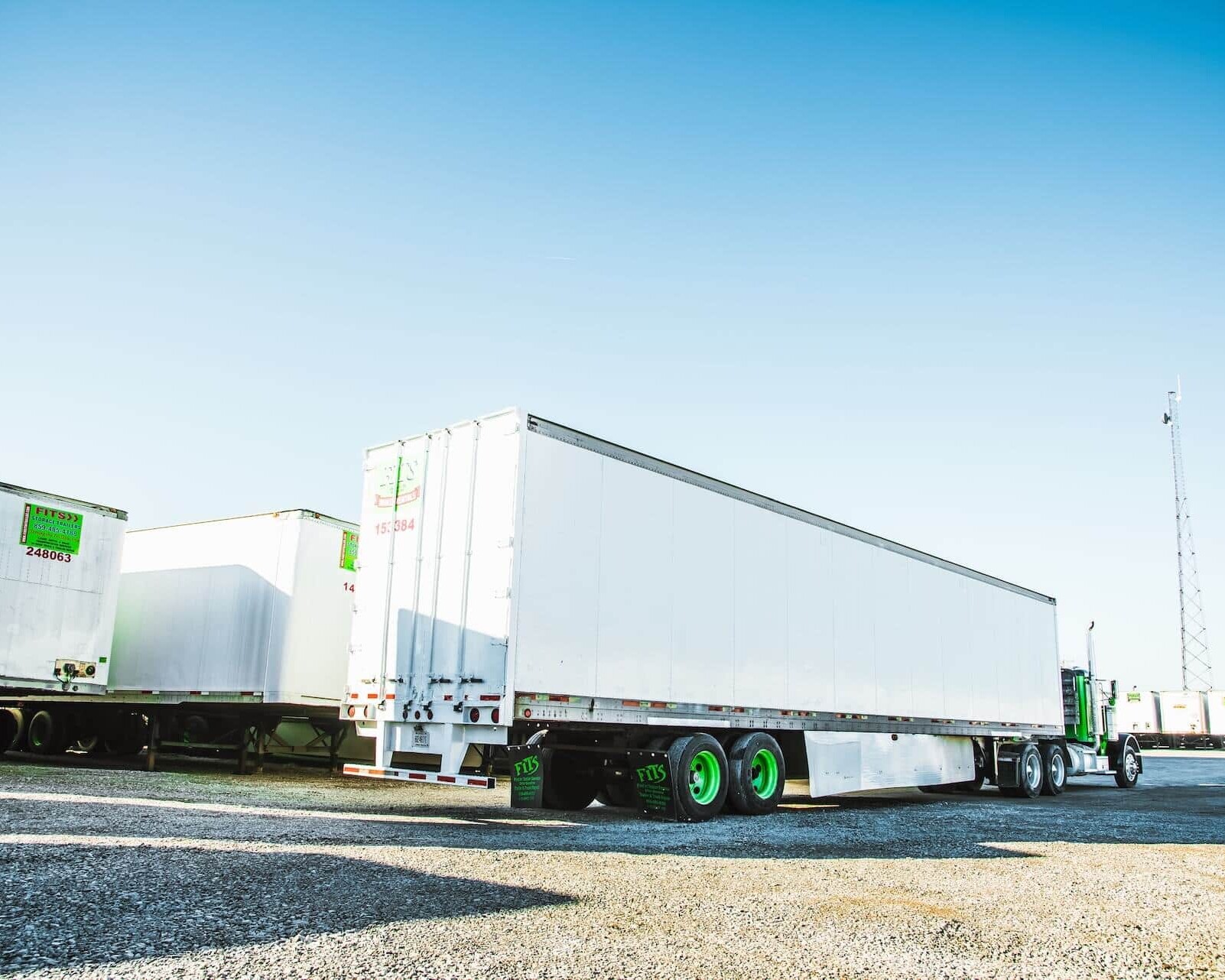
The dry van is the fully enclosed, box-shaped trailer that most people picture when they hear the word “semi.” It is the most common trailer type on US roads, handling the majority of non-bulk freight and covering almost every on-site storage use case our customers encounter.
Key features:
- Fully enclosed with a rigid roof and side walls
- No temperature control (no refrigeration, no heating)
- Available in 28-foot, 45-foot, 48-foot, and 53-foot lengths, with 53-foot dominant
- Rear swing doors or roll-up doors, dock-height compatible
- Weather-sealed and lockable for cargo security
Dry vans carry everything from packaged consumer goods and palletized inventory to electronics, apparel, furniture, and dry food. The same features that make them dominant in freight (enclosed, weatherproof, dock-compatible) are what make them the default for storage, which we will cover below.
Refrigerated Trailers (Reefers)
A reefer is a dry van with insulated walls and a refrigeration unit bolted to the front bulkhead. The unit can hold interior temperatures anywhere from roughly minus 20°F to plus 80°F, which is why reefers move most temperature-sensitive freight in the US.
Typical cargo includes fresh and frozen food, dairy, produce, pharmaceuticals, chemicals that require a specific temperature range, and floral products. The tradeoff is ongoing cost: the refrigeration unit runs on diesel or shore power, consumes fuel during transit, and must stay powered during any layover. Reefers also give up roughly 10 percent of interior volume to insulation and equipment. That cost profile is why reefers are rarely used for general storage unless the contents specifically require temperature control.
Flatbed Trailers
A flatbed is an open platform trailer with no sides and no roof. The appeal is loading flexibility: a flatbed can be loaded from the top, either side, or the rear, which matters when the cargo is too large, too heavy, or too awkwardly shaped to fit through a swing door.
Flatbeds typically carry construction materials, structural steel, lumber, machinery, prefabricated building components, and equipment. Standard flatbeds handle cargo up to about 48,000 pounds and 8.5 feet in height. They are also the foundation for the step deck and lowboy variants described below. The lack of weather protection rules them out for on-site use case where the materials need to stay dry, but can be used when equipment or materials won’t fit in a dry van.
Step Deck (Drop Deck) Trailers
A step deck is a flatbed with two deck levels: a shorter upper deck over the fifth-wheel coupling and a longer lower deck that sits closer to the ground. That lower deck, usually about 3 feet 3 inches off the pavement, is what lets the trailer carry cargo that would exceed legal height limits on a standard flatbed.
The legal cargo height on a step deck is about 10 feet, compared to 8.5 feet on a standard flatbed. That extra clearance is the entire reason the configuration exists. Step decks typically haul construction equipment, prefabricated wall sections, tall industrial machinery, and oversized components that still fit inside legal width limits.
Lowboy Trailers
A lowboy trailer uses a double-drop design, with two deck-height drops that position the main cargo deck extremely close to the ground. That low clearance is what allows a lowboy to haul cargo up to roughly 11.5 to 12 feet tall without oversize permits.
Lowboys are the trailer of choice for heavy construction equipment: excavators, bulldozers, cranes, large generators, and similar machinery. Many lowboys can also add extra axles to distribute weight, pushing legal loads up to 80,000 pounds or higher with permits. Lowboys are purpose-built for moving heavy, tall machinery from one job site to another. They are not used for stationary storage.
Tanker Trailers
Tanker trailers are cylindrical by design, and the shape is not cosmetic. A cylinder distributes pressure evenly and keeps the center of gravity low, which matters when the cargo is liquid and can slosh during turns.
Tankers carry fuel, chemicals, milk, water, liquefied gases, and dry bulk materials like flour, sugar, plastic pellets, or cement. Subtypes include petroleum tankers, asphalt tankers with heated linings, pneumatic tankers for dry bulk, and stainless-steel food-grade tankers. Tankers require specialized hazmat-endorsed CDL operators and FMCSA compliance for most loads. Their cylindrical design also makes them unusable for palletized or boxed storage, which is why they never enter the storage conversation.
Other Trailer Types (Quick Reference)
A handful of specialty configurations round out the category. They show up in specific industries and on specific routes, and they are worth knowing about even if none are relevant for typical storage needs.
- Extendable trailers: Telescoping flatbeds that stretch for oversized loads like bridge beams, wind turbine blades, and long piping.
- Side curtain trailers: Dry van frames with retractable fabric side panels. Combines weather protection with flatbed-style side loading. Common in European freight and US manufacturing yards.
- Dump trailers: Hydraulically tipping open trailers used for aggregates, sand, gravel, and demolition debris.
- Schnabel trailers: Ultra-heavy-haul rigs built to carry single industrial components up to about 1,000 tons (power transformers, reactor vessels).
- Car haulers: Multi-level auto transport trailers for new and used vehicle movement.
- Livestock trailers: Ventilated enclosed trailers for live animals, with compartmented interiors and specialized flooring.
For almost any commercial storage, construction overflow, or seasonal inventory need, the shortlist narrows fast. The next section is where it narrows.
Which Semi-Trailer Types Are Actually Used for Storage?
Once the use case shifts from “move cargo from A to B” to “park this somewhere and use it as a secure space,” most trailer types eliminate themselves in about ten seconds of honest evaluation.
Here is how that filter works in practice:
| Trailer Type | Enclosed? | Weather-Protected? | Ongoing Cost to Hold Cargo? | Dock-Compatible? | Viable for Storage? |
|---|---|---|---|---|---|
| Dry van | Yes | Yes | None | Yes | Yes |
| Reefer | Yes | Yes | Fuel or power to run the unit | Yes | Only if temperature-controlled storage is required |
| Flatbed | No | No | None | Not relevant | Yes |
| Step deck | No | No | None | Not relevant | No |
| Lowboy | No | No | None | Not relevant | No |
| Tanker | Enclosed but cylindrical | Yes | None | No | No |
Reefers are technically viable, but the ongoing fuel or shore-power requirement makes them expensive to hold inventory in unless the contents actually need the temperature control. Flatbeds, step decks, and lowboys have no weather protection, which rules them out for anything that is not rated for full outdoor exposure. Tankers are enclosed, but the cylindrical shape means you cannot stack pallets, install shelving, or move people and equipment through the interior.
For storage, the field narrows to enclosed trailers. And within that category, one specific configuration has become the default for nearly every major distribution, retail, and industrial facility in North America: the 53-foot dry van.
The 53-Foot Dry Van Trailer: Why It Became the Storage Standard
The 53-foot dry van is the default trailer on US highways, the default trailer at US warehouse docks, and the default trailer that storage rental providers ship to customer sites. Its dimensions are optimized for US interstate regulations, US dock infrastructure, and US pallet standards. If you are considering a semi-trailer for on-site storage, this is almost certainly the unit you will end up with.
Dimensions and Usable Space
A standard 53-foot dry van has interior dimensions of approximately 52 feet 6 inches long, 8 feet 2 inches wide, and 8 feet 10 inches tall. That works out to roughly 430 square feet of usable floor space and about 3,800 cubic feet of interior volume. The standard rear swing-door opening is 7 feet 8 inches wide by 8 feet 9 inches tall. Cargo weight capacity is typically 42,000 to 45,000 pounds.
For context: 430 square feet is comparable to a large retail backroom, a mid-sized warehouse bay, or a two-car garage with a few feet to spare. Because a 53-foot trailer sits at dock height, it integrates directly with standard loading dock equipment, which means most facilities can start using a trailer the same day it arrives. Interior tie-down points allow customers to install shelving, racking, or pallet organization without modifying the trailer structure.
Pallet Capacity
A 53-foot dry van holds:
- 26 standard GMA pallets (40 inches by 48 inches) single-stacked in a straight two-wide configuration. This is the standard answer in logistics and the one worth memorizing.
- 28 pallets using a pinwheel or alternating loading pattern that squeezes extra units into the same floor footprint.
- Up to 52 pallets double-stacked, for cargo that is stable and light enough to stack safely.
For storage specifically (where the trailer is stationary, not in transit), double-stacking is more realistic than it would be for freight, because there is no road vibration or sudden braking to worry about. Many customers plan their internal layout around 26 to 52 pallet positions depending on the product.
Why 53 Feet Became the Industry Standard
Before the 1990s, the 48-foot trailer was the US standard. The shift to 53 feet happened as retailers and distributors pushed for higher-volume loads to reduce per-unit shipping cost, and as state and federal regulations settled on 53 feet as the maximum trailer length permitted on US interstate highways without special oversize permits.
Once 53 feet became the legal ceiling, the rest of the supply chain aligned around it:
- Distribution centers and warehouse docks were built or retrofitted to accommodate 53-foot trailers.
- Fleet operators standardized on 53-foot equipment for maximum cargo volume per load.
- Manufacturers of pallets, racking, and loading equipment designed their products around 53-foot interior dimensions.
Today, 53 feet is the default specification for nearly every major US distribution center, most retail distribution networks, and almost all major national fleet operators. Forty-eight-foot trailers still exist and are useful in dense urban areas where maneuverability matters more than volume, but they are a minority of the national fleet.
53-Foot vs 48-Foot: What’s the Difference?
Both trailers are dry vans. The difference is 5 feet of length, and that 5 feet translates into real capacity:
| 53-Foot Dry Van | 48-Foot Dry Van | |
|---|---|---|
| Interior length | 52′ 6″ | 47′ 6″ |
| Floor space | ~430 sq ft | ~385 sq ft |
| Interior volume | ~3,800 cu ft | ~3,400 cu ft |
| Pallets (single-stacked) | 26 | 24 |
| Weight capacity | 42,000–45,000 lbs | Comparable per axle |
| Best for | Maximum volume, standard dock | Tight yards, urban delivery |
| Industry standard | Yes | Less common |
For almost every storage application, the 53-foot dry van is the right answer. The two extra pallet positions and roughly 45 additional square feet are meaningful when you are staging inventory, and the 53-foot format aligns with nearly every dock and dock seal in North America.
Warehouse on Wheels: 36,000+ Trailers, One Standard
Warehouse on Wheels operates a fleet of nearly 40,000 53-foot dry van trailers across the United States, Canada, and Mexico, delivered to customer facilities in 24 to 48 hours. More than 7,000 customers, from startups to Fortune 100 companies, rely on WOW for mobile warehousing that integrates with existing dock infrastructure. The fleet is deliberately standardized on one configuration because that is the configuration that works for on-site storage.
Fleet scale matters for two practical reasons. First, availability: a 36,000+ unit fleet means a trailer is typically available in every major market, not just in a handful of regional yards. Second, consistency: every trailer is the same specification, so a customer renting in Dallas gets the same interior dimensions, the same door sizes, and the same dock compatibility as a customer renting in Toronto or Monterrey. That matters when you are managing multi-site inventory or planning a national rollout.
Customers load, access, and manage the trailer on their own schedule for the duration of the rental. No transportation contracts. No freight pickups. No warehouse lease.
If you have gotten this far and your facility is dealing with overflow, seasonal inventory, or a temporary space constraint, the 53-foot dry van is the industry-standard answer and WOW is the company with the fleet to deliver it.
Frequently Asked Questions About Semi-Trailers
What is the most common type of semi-trailer?
The dry van is the most common type of semi-trailer in the United States. It handles the majority of general freight, and its enclosed, weatherproof, dock-compatible design makes it the default trailer for both transportation and on-site storage.
How many pallets fit in a 53-foot trailer?
A 53-foot dry van trailer holds 26 standard GMA pallets single-stacked in a straight configuration, or up to 28 pallets using a pinwheel loading pattern. If the cargo is stable and light enough to stack, a 53-foot trailer can hold up to 52 pallets double-stacked.
What’s the difference between a 48-foot and 53-foot trailer?
A 53-foot trailer is 5 feet longer than a 48-foot trailer, which translates to roughly 45 more square feet of floor space and room for 2 additional standard pallets. The 53-foot dry van replaced the 48-foot as the US industry standard in the 1990s and now dominates most US distribution, retail, and storage applications.
Which semi-trailer type is best for storage?
The 53-foot dry van is the best semi-trailer type for on-site storage. It is fully enclosed, weatherproof, and dock-compatible, and it is the most widely available trailer type in North America. Reefer trailers work for temperature-sensitive storage but require ongoing fuel or power, which adds cost. Flatbeds, step decks, lowboys, and tankers are not designed for stationary storage use.
How much does it cost to rent a 53-foot dry van trailer for storage?
Storage trailer rental costs vary by market, volume, and contract length. Based on Warehouse on Wheels’ Economic Benefit Analysis, trailer storage averages $6.64 per square foot compared to $11.05 per square foot for traditional warehouse leasing before operating costs are added. For the full five-year cost comparison, see our guide to the real cost of trailer storage vs. warehouse leasing.
What is the interior height of a 53-foot trailer?
A standard 53-foot dry van trailer has an interior height of approximately 8 feet 10 inches. The standard rear swing-door opening is 8 feet 9 inches tall and 7 feet 8 inches wide, so most standard pallets, racking, and small equipment fit through the door without modification.
Can a semi-trailer be used as a permanent storage unit?
Semi-trailers are most commonly used for temporary or overflow storage: seasonal spikes, construction site material storage, facility renovations, or bridging the gap while new warehouse space is built. For longer-term needs, trailer rental providers like Warehouse on Wheels offer flexible lease terms that scale with the project.
Round Up
There are six main types of semi-trailers in regular US use, and each is built for a different kind of cargo. Flatbeds, step decks, and lowboys haul heavy, oversized, or open loads. Tankers haul liquids and bulk. Reefers haul temperature-sensitive freight. Dry vans haul nearly everything else.
For on-site storage, the answer narrows quickly. The 53-foot dry van is the US industry standard because it is enclosed, weatherproof, dock-compatible, and built to the maximum legal trailer length for US highways. It is the configuration nearly every distribution network in North America is designed around.
Warehouse on Wheels operates nearly 40,000 of them, and if you need space fast, they can be delivered in 24 to 48 hours.