
3PL Overflow Storage or On-Site Storage Trailers: Which Is Right for Your Inventory?
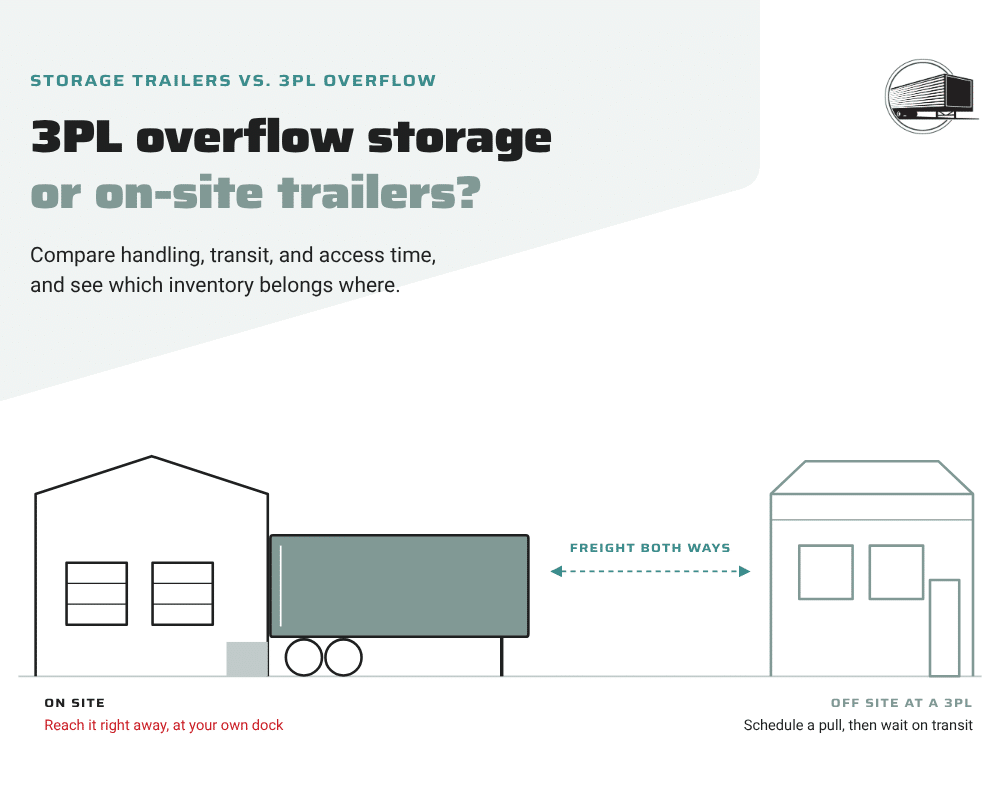
3PL overflow storage takes inventory off your hands, but it adds handling fees, freight both ways, and lead time whenever you need product back. Storage trailers keep overflow at your own dock, where your team can reach it right away. Use a 3PL when you want someone else to receive, store, and ship; keep overflow on site when you need fast, frequent access.
Your building is full, and a 3PL has offered overflow space. On paper it’s easy: send the pallets out, free up the floor, get back to running the plant. Then the real questions start. What does it cost to move product out and bring it back? How long does the line wait when the raw material it needs is sitting across town? And who’s keeping eyes on what’s in there?
Those are the right questions to ask. This guide puts 3PL overflow storage and on-site storage trailers side by side, lists the 3PL storage fees to ask about, and gives you a simple way to split overflow so every pallet lands where it makes sense. It’s one of several head-to-head comparisons in our guide to temporary storage options for business.
3PL overflow storage vs. on-site storage trailers at a glance
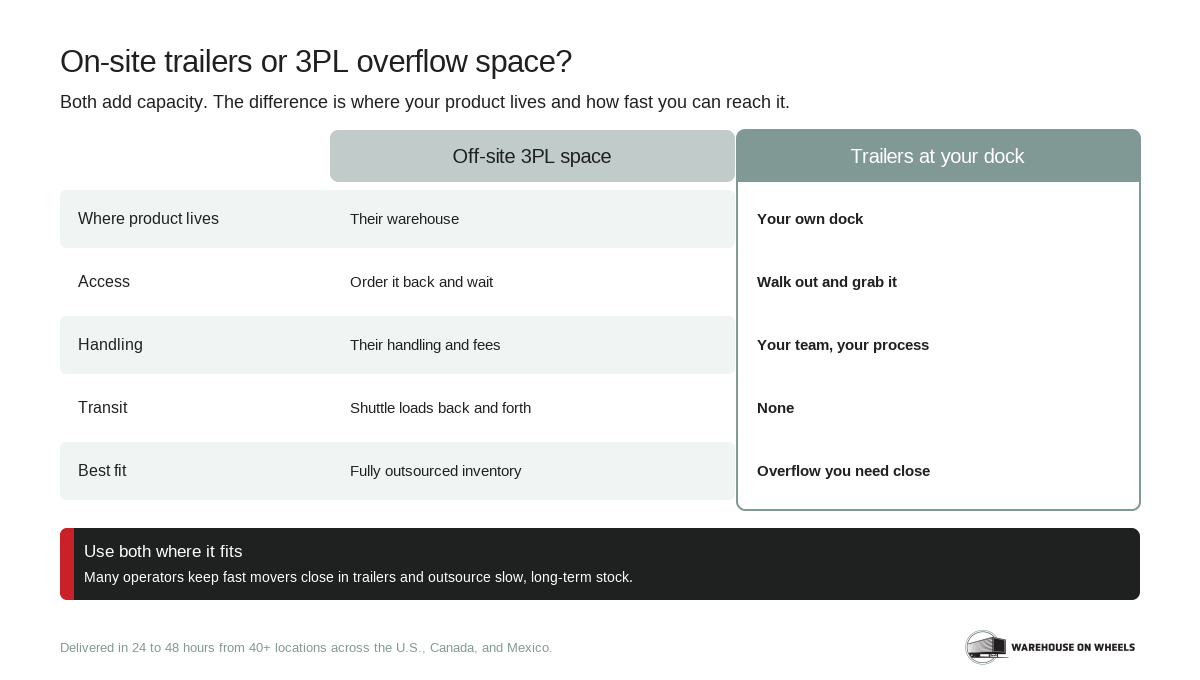
Both options add capacity. The difference is where your product lives, who touches it, and how fast you can get it back.
| 3PL overflow storage | On-site storage trailers from Warehouse on Wheels | |
|---|---|---|
| Where product sits | In the 3PL’s warehouse, off site | At your own dock or yard |
| Who handles it | The 3PL’s team receives, stores, and pulls it | Your team, by forklift straight from receiving |
| Access time | Schedule a pull, then wait on transit back | As long as it takes to drive a forklift to the dock |
| What you pay for | Receiving, storage, pulls, outbound handling, plus freight both ways | A monthly trailer rental, with no fee each time a pallet moves |
| Time to add space | Depends on open space and onboarding | Delivered in 24 to 48 hours |
| Control and visibility | The 3PL’s systems and reports | Your own team’s eyes, plus GPS tracking and geo-fencing on each trailer |
| Best fit | Long-hold stock, fulfillment services, no yard space, multi-market distribution | WIP, raw materials, fast movers, anything touched weekly |
The 3PL storage fees to ask about
A 3PL quote usually breaks into several fee types, and overflow inventory can touch most of them every time it moves. That’s not a knock on 3PLs. Every receipt, pallet position, and pull takes labor, and that’s how warehousing work gets priced. Before you put a 3PL quote next to a trailer rental, ask how each of these is billed:
- Receiving. Unloading and checking in your inbound pallets, often billed per pallet, per container, or per labor hour.
- Storage. The space your product takes up, often billed per pallet position, square foot, or bin each month. Ask whether a long-term storage surcharge applies to stock held past a set period.
- Pick or pull. Pulling your pallets back out when you need them.
- Outbound handling. Staging and loading product for the trip back to your building.
- Freight both ways. Getting product to the 3PL and back to your dock is usually a separate carrier bill, not part of the warehouse invoice.
- Setup and minimums. Some warehouses charge an onboarding fee or set a monthly minimum spend.
Fee types summarized from Extensiv’s 3PL pricing guide (October 2026).
Once you have the answers, add up one round trip for one pallet, then multiply by how often you expect that pallet to move. For product that sits for months, the math can work in a 3PL’s favor. For product your line pulls every week, the trips add up.
Access and control: how fast can you get product back?
With a 3PL, getting product back means scheduling a pull and waiting on transit. With a storage trailer, it means walking out to the dock. For long-hold stock, a day or two of lead time rarely matters. For WIP, raw materials, and fast movers, that wait can idle a line or push a ship date.
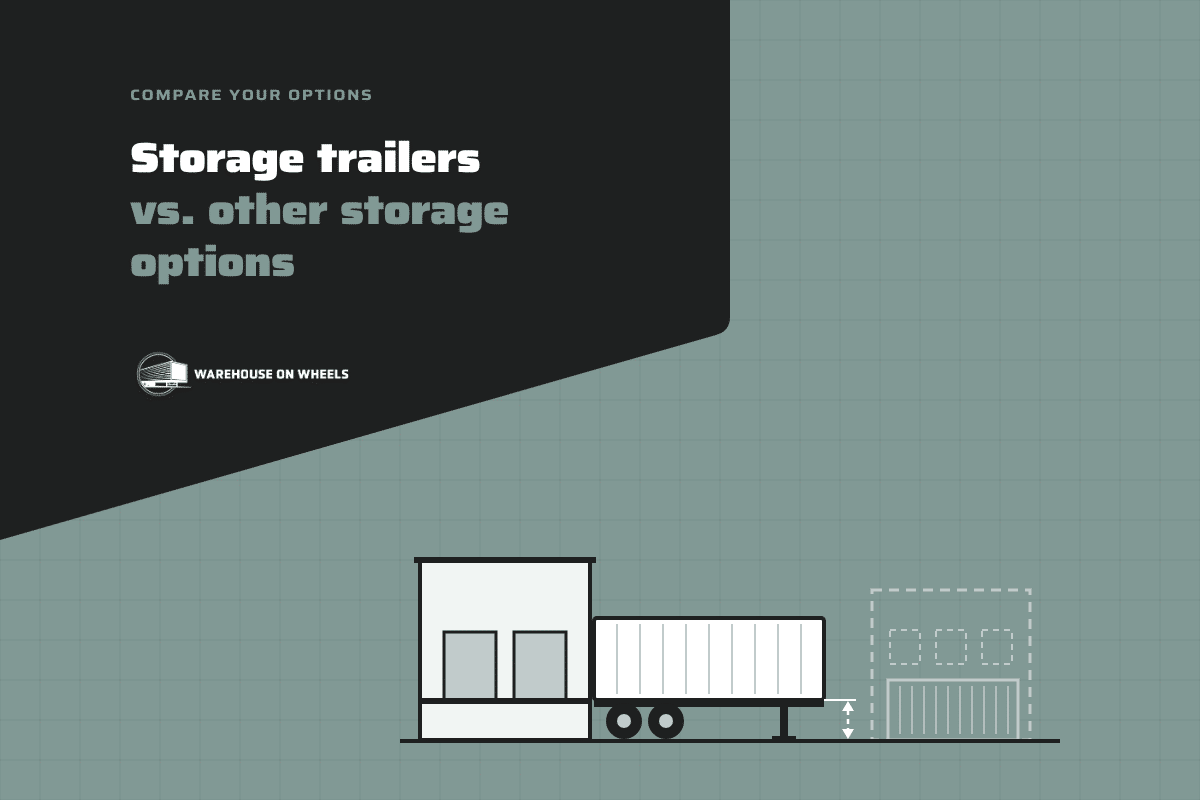
A storage trailer sits at dock height, about 52 inches, so forklifts drive straight in from receiving. That’s also what separates it from a shipping container, which sits on the ground and gets loaded from the lot. Warehouse on Wheels delivers in 24 to 48 hours from more than 40 locations across the United States, Canada, and Mexico, and the trailer stays put until you send it back. That setup is different from renting an over-the-road trailer, which the lessor needs back on the road.
Control matters as much as speed. When overflow sits at your dock, your own team counts it, rotates it, and knows where it is. GPS tracking and geo-fencing on Warehouse on Wheels trailers show where each unit sits, and a simple labeling system tells your crew what’s inside each one.
Splitting overflow: what goes to a 3PL and what stays at your dock
You don’t have to send everything out or keep everything in. Sort overflow by how often your team touches it. Slow movers and long-hold stock can go off site. Product the line or shipping team touches every week stays at the dock.
Worked example: sorting 3PL overflow storage by velocity, slowest SKUs first
Here’s a sample scenario: a mid-size industrial manufacturer heading into its fall build. The building is full, and about 120 pallets of overflow need a home. The team starts with the slowest-moving SKUs and works up to the fastest:
- Pull out the lowest-velocity SKUs first. These get touched a few times a year or less. In this example, that’s 35 pallets of spare parts, service stock, and long-hold inventory. If the yard is tight, they’re the best candidates for 3PL overflow storage, because they rarely make the round trip.
- Price the middle both ways. Next come the SKUs touched about once a month: 25 pallets. Count the handling and freight each time product moves, then compare that to keeping them in a trailer at the dock.
- Keep the fastest movers at the dock. The last 60 pallets get touched weekly or more: raw materials, WIP, and top sellers. They go into storage trailers, so the team reaches them without a scheduled pull.
Packaging supplies are another good example. Corrugate and shrink wrap take up a lot of floor space and get pulled every shift. Moving them into a storage trailer at the dock frees up room inside without slowing down the packing line.
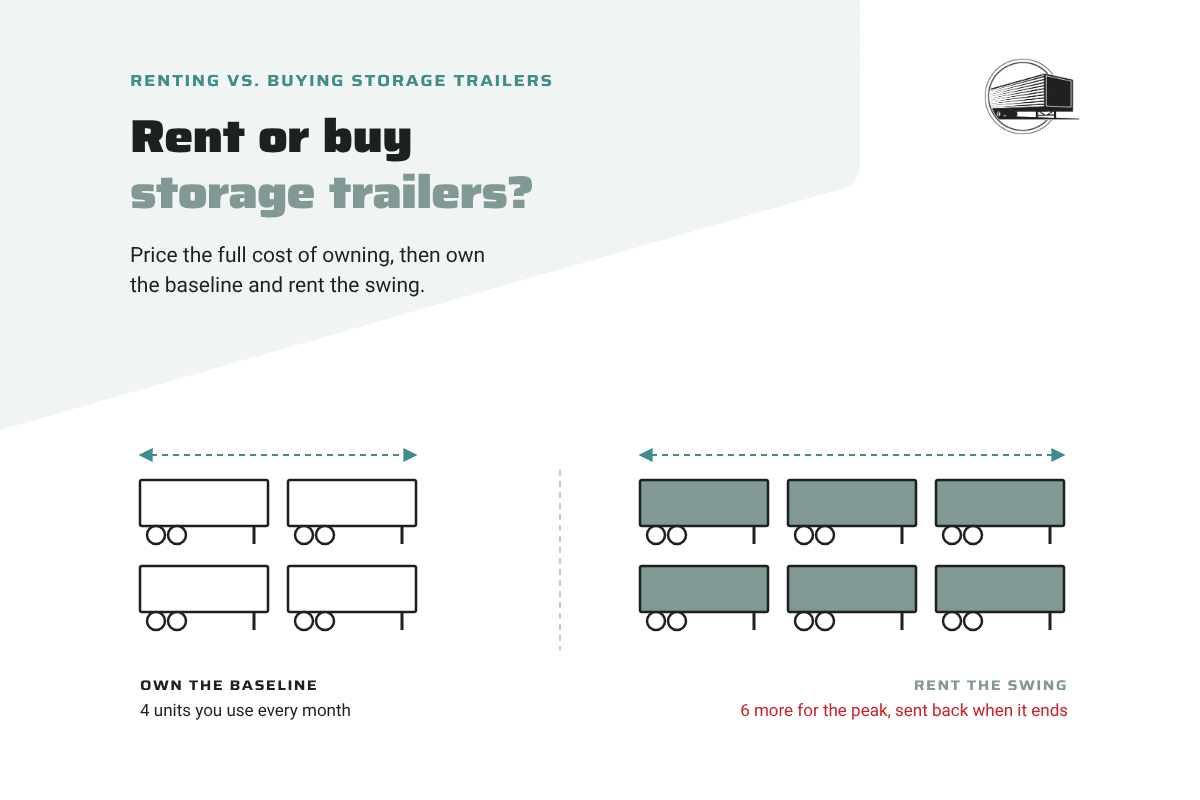
If the dock-side portion stays the same every month for years, it’s worth weighing renting vs. buying storage trailers.
When a 3PL is the better choice
A 3PL is the better choice when you want someone else to run the warehouse work, not just hold the product. Good 3PLs do that work well, and for some overflow they’re the right partner. A 3PL likely wins if:
- You have no yard space. If there’s nowhere to park a trailer near your dock, off-site storage may be the practical answer.
- You need fulfillment services. Pick and pack, kitting, and shipping straight to customers are what 3PLs are built for. A storage trailer holds product; it doesn’t ship orders.
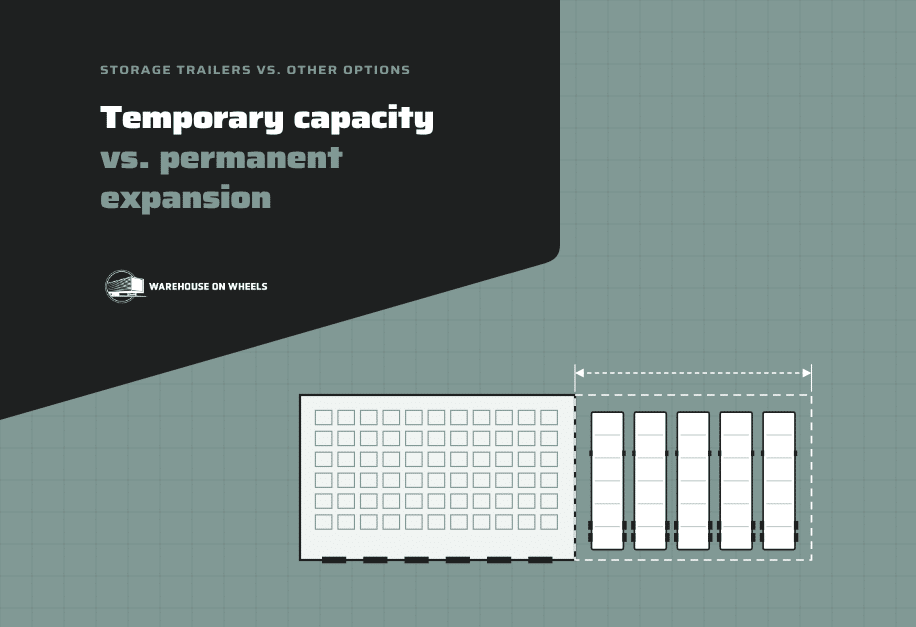
- The overflow is long term. If the extra volume has become your new normal, it isn’t overflow anymore. Compare storage trailers with a warehouse lease and weigh temporary capacity against permanent expansion.
- You distribute to several markets. A 3PL with buildings near your customers can shorten delivery times in regions you don’t serve from your own dock.
It also doesn’t have to be one or the other. Plenty of operations keep fast movers at the dock in trailers and send long-hold stock to a 3PL. And many 3PLs use storage trailers themselves when a new customer or a seasonal surge outgrows their building.
Frequently asked questions
What fees do 3PLs charge for overflow storage? Most 3PL overflow storage quotes include receiving, monthly storage, pulls, and outbound handling, and some add setup fees or monthly minimums. Freight to and from the 3PL is usually billed separately by your carrier. Ask how each fee is billed so you can compare a full round trip.
Can I keep overflow on site if my yard is tight? Often, yes. A few trailers can fit along a fence line, in unused parking, or at a spare dock door. If there’s truly no room, ask your local Warehouse on Wheels team about off-site options.
How do I track inventory stored in trailers? Label every pallet, assign each trailer an ID, and keep a simple log of what’s in which unit. GPS tracking and geo-fencing on Warehouse on Wheels trailers add a layer of visibility. The tracking guide linked above walks through a full setup.
Do 3PLs use storage trailers too? Yes. Many 3PLs add storage trailers at their own docks to take on new customers or handle seasonal surges without leasing more space.
Can I use a 3PL and storage trailers at the same time? Yes, and it’s often the best setup. Keep product your team touches weekly at the dock in trailers, and send long-hold stock to a 3PL.
Keep the overflow you need where you can reach it
The best overflow plan puts each pallet where it costs the least to reach. For long-hold stock, that might be a 3PL. For the product your line and shipping team touch every week, it’s a storage trailer at your own dock.
See what keeping overflow on site could save. Try the Warehouse on Wheels Savings Calculator
Want overflow you can reach from your own dock? Talk to your local Warehouse on Wheels team, and we’ll tell you straight which inventory belongs where. Find your local Warehouse on Wheels team
Weighing more than two options? Our side-by-side look at temporary storage options shows how storage trailers stack up against leases, containers, 3PL space, and more.