Storage Trailer vs. Warehouse Lease: Which Makes Sense for Your Space Need?
For short-term or seasonal space needs, storage trailers usually cost less than a warehouse lease. There’s no multi-year term, no build-out, and no NNN charges, and trailers arrive in 24 to 48 hours instead of months. For permanent, steady volume that fills the space year-round, a lease can make more sense.
If you’re short on space and someone on the leadership team has floated leasing a second building, you’re probably stuck on the same question: is this a five-year problem or a five-month problem? This guide gives you a side-by-side view, a simple way to test your own situation, and a straight answer on when a lease is the better call. It’s one piece of our larger comparison of storage trailers vs. other storage options.
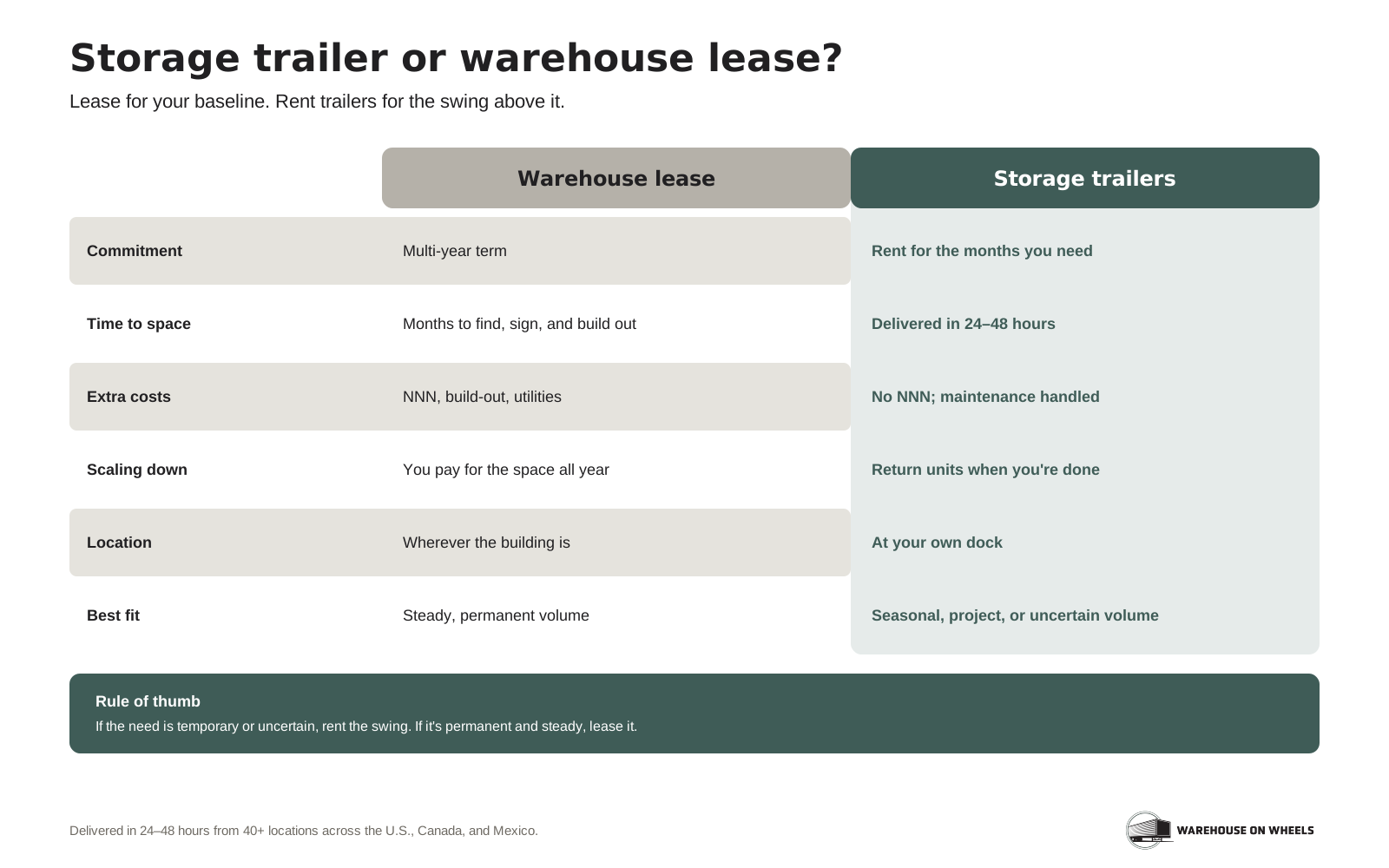
Storage trailer vs. warehouse lease at a glance
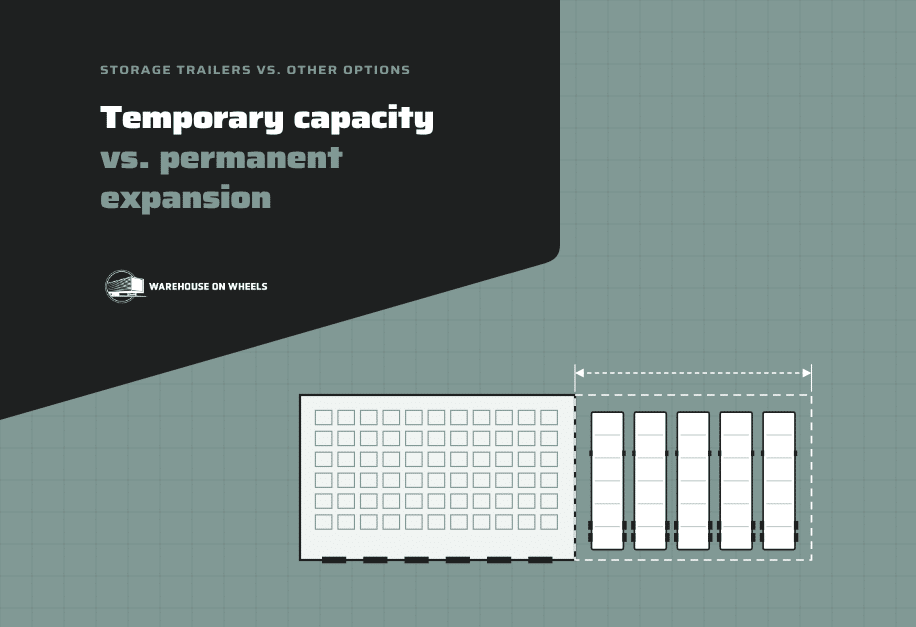
A lease buys you a building for years. A storage trailer rental buys you dock-height space for as long as the overflow lasts.
What a warehouse lease really costs beyond rent
The rent on the listing is only the starting line. Most industrial leases are triple net, or NNN, which means the tenant pays base rent plus a share of the building’s property taxes, insurance, and common area maintenance like parking lot upkeep and snow removal (Link Logistics, Jan. 2026). Those charges can move year to year, and you carry them for the whole term.
Then come the costs that don’t show up in the lease at all:
- Build-out. Racking, lighting, dock equipment, and security. Many leases also require you to restore improvements to original condition when you leave.
- A second operation. A crew, a forklift, utilities, and someone to manage it, all at a building that isn’t your main one.
- Shuttle runs. Every pallet stored across town has to be trucked back when you need it.
- The term. Industrial leases typically run 5 to 10 years, with 5 the most common (Link Logistics). If the space crunch lasts one peak season, you’re still paying in year four.
Kelly McCane, a Warehouse on Wheels General Manager, starts with the space a customer is already paying for. “Are you storing anything in here that you don’t need? That’s question number one,” he says. “You have all this space that you’re paying a high premium for. If you have things sitting around in here, get rid of it.” Sometimes that means a few trailers to haul out old material instead of a full rental program. Clear the floor first, then size the overflow.
The math that decides it: how many months you actually need the space
The deciding number is how many months a year you’re over capacity. A lease charges you 12 months a year for every year of the term. Trailers charge only for the months and the units you’re using. Here’s how to test your own situation (illustrative example, use your own quotes):
-
- Count your months over capacity. Example: 4 months, August through November.
- Price the lease sized for that peak. You pay for it all 12 months, every year of the term, plus NNN, build-out, and a crew at a second site.
- Price trailers sized for the same overflow. You pay for 4 months, only for the units in use, and they sit at the dock your crew already works.
- Compare the two totals. The fewer months you need the space, the more the math favors trailers. If you’re full 12 months a year, price the lease.
For what goes into a trailer quote, see how much it costs to rent a storage trailer. Depending on the market, Warehouse on Wheels storage trailers run two to four times less than traditional warehouse space.
Speed and flexibility
Trailers arrive in 24 to 48 hours. A lease takes months to find, negotiate, and fit out, and your space problem doesn’t wait that long.
Kelly puts the cost of waiting plainly. When a customer’s aisles are packed, he asks one question: “If the fire marshal walks in here today and says you’re shut down until you get this fixed, can your operation afford a 7, 14, 21 day shutdown?” He’s quick to add, “I don’t do it to scare you. I’m not a scare tactic type of sales guy.” The point is that you can still operate while you clean it up. A lease search can’t move that fast.
Flexibility runs the other way too. You add trailers as overflow grows and send them back as it shrinks, with no penalty for ending early. Kelly’s location moved about 511 trailers on and off rent in a recent 90-day stretch, roughly 250 going out and 250 coming back.
“That is what we do all day, every day. It proves the model works,” Kelly says. “If the model didn’t work, I would only have a bunch of on rents or a bunch of off rents. To have 500 trailers on and off rent in 90 days just goes to show you that it’s there when you need it, and when you’re done, get it turned in.”
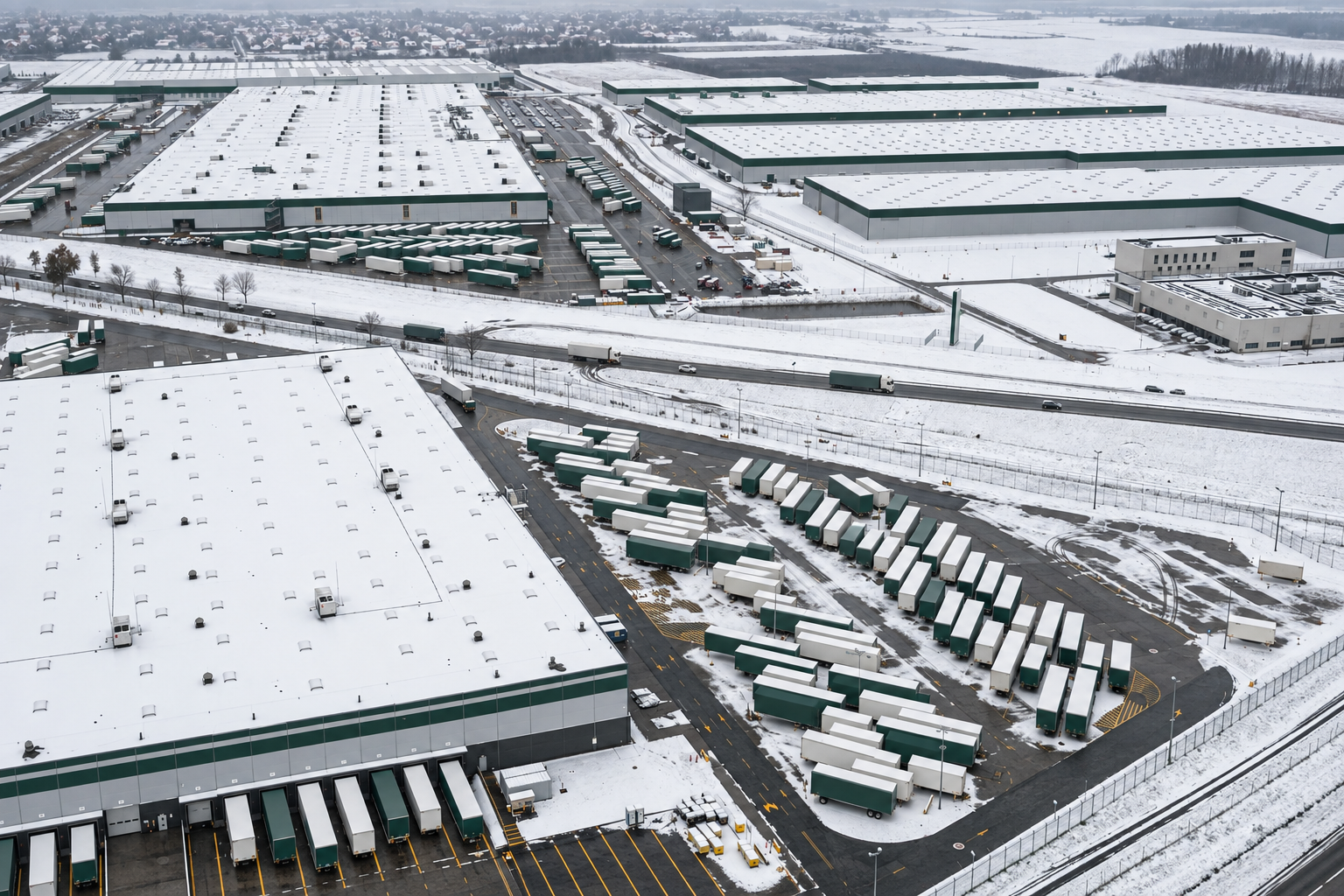
There’s also the question of where the space sits. Trailers park at your dock or in your yard, so your crew loads them with the same forklifts on the same shift.
When a warehouse lease makes more sense
A lease is the better call when the need is permanent and the space stays full. We’d tell you the same thing on a phone call. Look hard at a lease if:
- Your volume is steady year-round. If you’re over capacity 12 months a year with no sign of easing, you’re paying for permanent space either way.
- You need climate control or a staffed operation. Temperature-controlled product or a full pick-and-pack line belongs in a building.
- The footprint is very large. When the overflow is more than your dock doors and yard can work with trailers, a building starts to pencil out.
- You’re planning for long-term growth. A new market or a new product line that will be there in five years deserves its own space.
Using both: trailers alongside a lease
You don’t have to choose one. Many operations lease or own enough building for their steady baseline and rent trailers for the swing above it, instead of leasing for the peak.
One of Kelly’s customers, a packaging manufacturer, runs three buildings: a production site, a warehouse, and a distribution center. They already keep over 100 Warehouse on Wheels trailers on rent across the three to shuttle product between sites. This fall, a special project landed on top of their holiday build. More raw materials came in, more finished goods came off the line, and they needed room for their own packaging too.
“The aisles were filled everywhere. You could not walk through and get anything done,” Kelly says. Their yard was full too, so there was nowhere to park more trailers on site.
Kelly describes how one blocked area led to the next. “They can’t get to the raw materials because the finished product’s in the way. They can’t get to the finished product because there’s 10 trailers outside waiting to get offloaded. One problem creates the next problem, creates the next problem.”
Here’s how the Warehouse on Wheels team cleared it:
-
- Day one: The customer set aside six dock doors. Warehouse on Wheels dropped five empty trailers.
- Days two through eight: Each run, the driver dropped an empty, hooked up a loaded trailer, and hauled it back to the Warehouse on Wheels yard for storage. Five trailers a day.
- Result: 40 loaded trailers of finished goods stored at Warehouse on Wheels’ yard, and the plant back to normal operating capacity in eight days.
“By doing this, they were able to free up the space to where now everything is in synchronization again,” Kelly says. “Trailers can get dropped off with raw materials. They can offload raw materials, get them to the production line, then take the finished product and have that moved out. Our trailers solved that problem for them.”
The extra capacity lasts as long as the project and the holiday rush do. No new building, no five-year term. Kelly’s team is doing the same right now for another customer whose secondary warehouse got so full staff couldn’t walk the aisles: seven storage trailers, loaded and moved out ahead of peak season.
FAQ
What is NNN in a warehouse lease? NNN, or triple net, means the tenant pays base rent plus a share of the building’s property taxes, insurance, and common area maintenance. Those charges sit on top of rent and can change from year to year.
How long is a typical warehouse lease? Industrial warehouse leases typically run 5 to 10 years, with 5 years the most common, according to Link Logistics. Longer terms are negotiated when a tenant makes a large investment in the space.
Can I rent storage trailers for just a few months? Yes. Warehouse on Wheels storage trailers rent on 30-day agreements you can cancel any time. When you’re done, call your local team and they’ll schedule pickup.
Can trailers cover the gap while I find a warehouse? Yes. Trailers hold your overflow at your dock while you search, negotiate, and fit out a building, then go back when you move in.
Weighing a lease? Run your numbers first
If your space crunch comes and goes with the seasons, a five-year lease is a long answer to a short problem. If it’s here to stay, a lease may be the right call, and trailers can carry you until the building is ready. Either way, test it with your own numbers before you sign.
Try the Warehouse on Wheels Savings Calculator to see how trailers compare to a lease for your operation. Rather talk it through? Get a quote or call your local Warehouse on Wheels team for a trailer quote to put side by side with your lease numbers. We’ll tell you straight if a lease is the better fit.