Temporary Capacity vs. Permanent Expansion: When Does Each Make Sense?
Expand when the extra volume is your new baseline: it has lasted through several seasons, your forecast says it will keep growing, and you can wait for construction or a move. Use temporary capacity when the need is seasonal, tied to a project, or still uncertain, and to cover the months or years before an expansion is ready. Storage trailers can be at your dock in 24 to 48 hours, so you never have to make a permanent decision under pressure.
The floor has been full for a while. Pallets are staged in the aisles, receiving is working around overflow, and somebody at the board or ownership level has started asking the question out loud: is it time to build?
Sometimes the answer is yes. But an expansion is one of the biggest capital decisions an operation makes, and it takes a long time to deliver. Make that call while the dock is jammed and you risk building for a peak that never comes back, or waiting too long on growth that was real all along.
This guide gives you a short set of tests to tell a temporary spike from lasting growth, a plain look at what each path commits you to, and a way to cover the gap at your dock while you decide or build.
Is your space problem temporary or permanent?
Your space problem is permanent if the overflow shows up every month, has held through more than one full cycle, and isn’t tied to anything with an end date. Run these five tests against your last two years:
-
- Is it there every month, or only some months? Overflow that shows up in October and is gone by February is swing, not growth.
- Has it held through more than one full cycle? One busy year is a data point. Two in a row at the same level is a pattern.
- Is it tied to something with an end date? A contract, a product launch, a big project, or a one-time inventory build will end, and the space need ends with it.
- How confident is the forecast? If leadership would bet capital on the number, that’s one thing. If the forecast reads “probably,” that’s another.
- Would new space sit empty part of the year? If an addition would be half full every spring, you’d pay year-round for a few months of need.
If three or more answers point to steady and lasting, you’re looking at permanent growth. If most point to seasonal or uncertain, temporary capacity is the better fit, at least for now.
What permanent expansion involves
Permanent expansion means one of three paths: add on to your current building, build a new facility, or relocate to a bigger one. Each is a lasting answer, and each comes with a lasting commitment.
- Add on. Capital, permits, and approvals, then construction next to a working operation. Expect crews, equipment, and closed-off docks or yard space while the work runs.
- Build new. The largest capital commitment and usually the longest wait: site selection, approvals, construction, and fit-out. You also take on running a second site, or a full move once it opens.
- Relocate. A lease or purchase on a bigger building, plus the cost and downtime of moving the whole operation.
All three are measured in months to years, depending on scope, approvals, and your market. In every case, the capital is committed early, before the new space holds a single pallet.
Leaning toward leasing more space instead of building? “storage trailer vs. warehouse lease” covers what a lease commits you to.
What temporary capacity covers
Temporary capacity adds space fast without a capital project. The main options are storage trailers, short-term warehouse space, and 3PL overflow.
For an operation with a dock, storage trailers do a few things the others can’t:
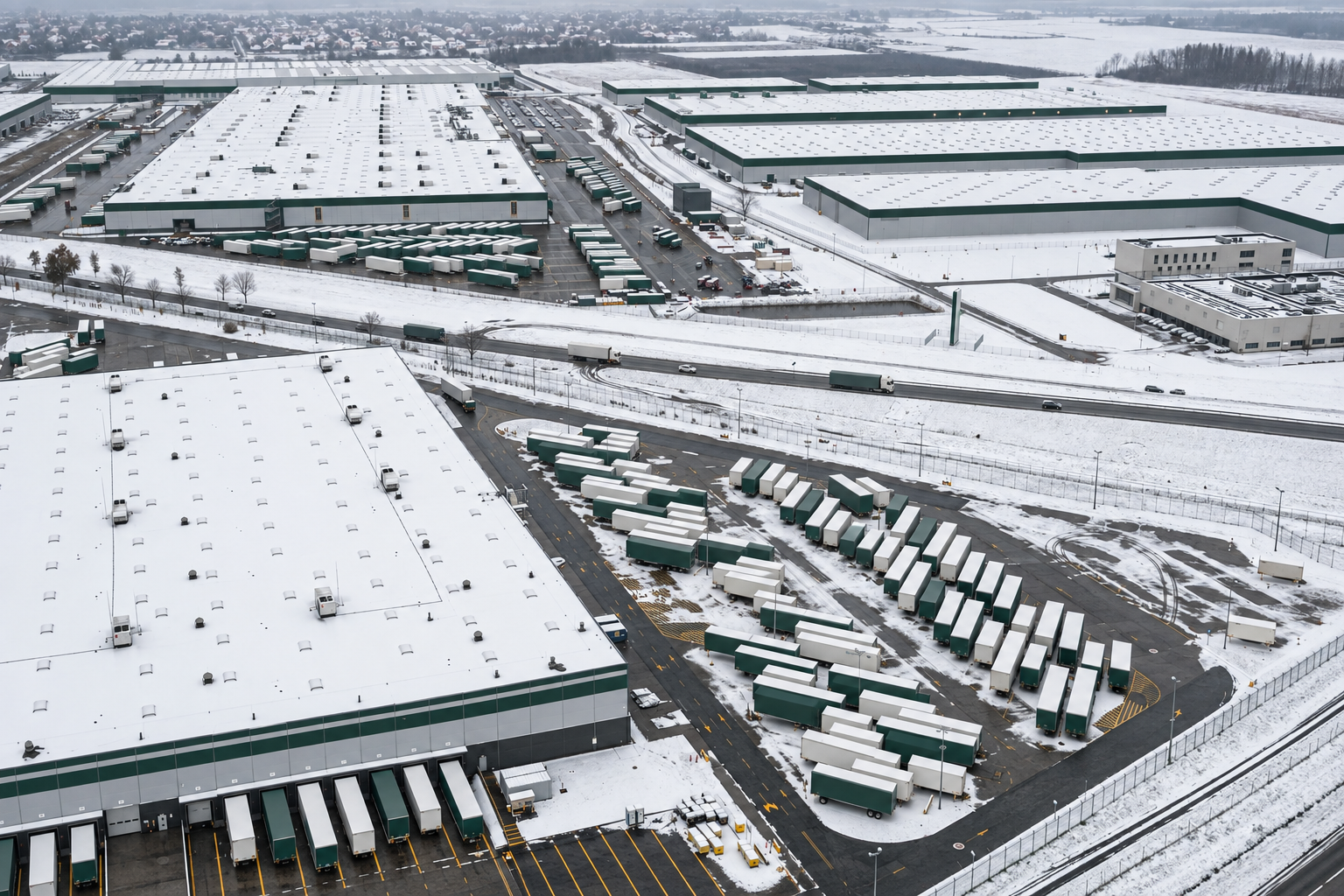
- Space at your own site in 24 to 48 hours. Trailers are delivered to your dock or yard, so overflow stays a few steps from receiving, not across town.
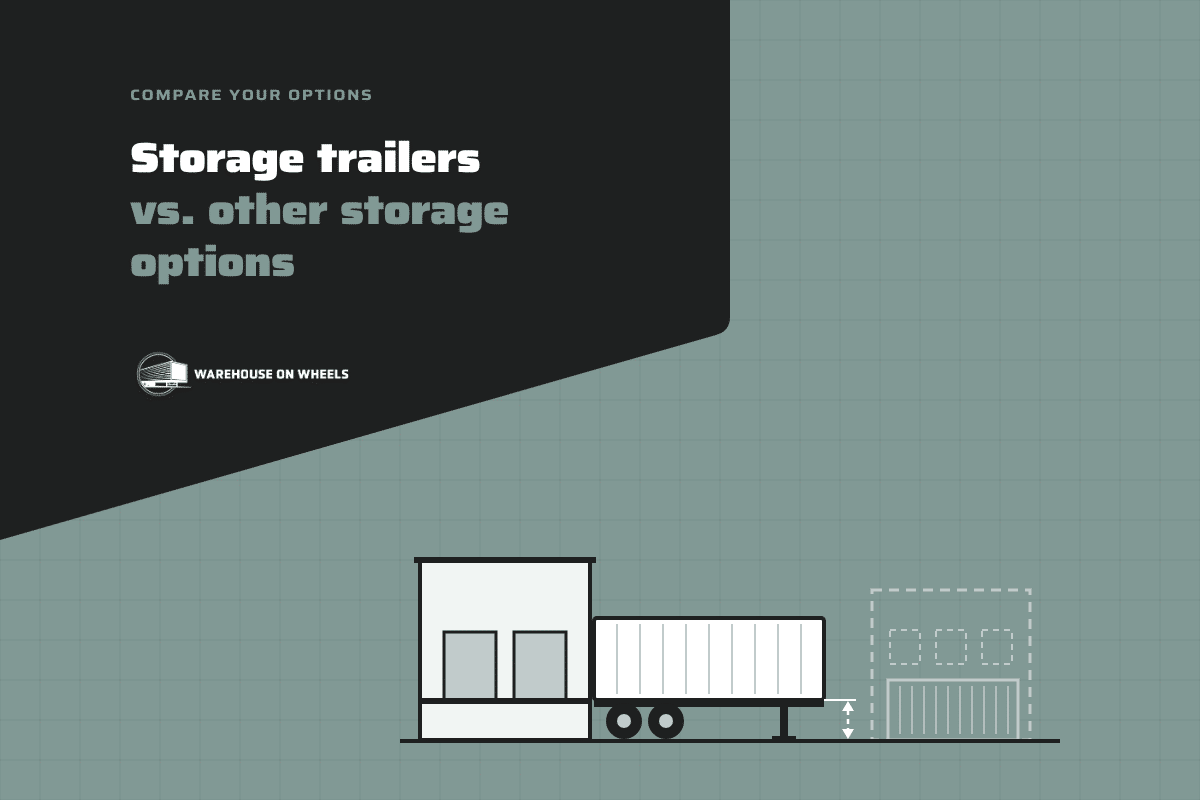
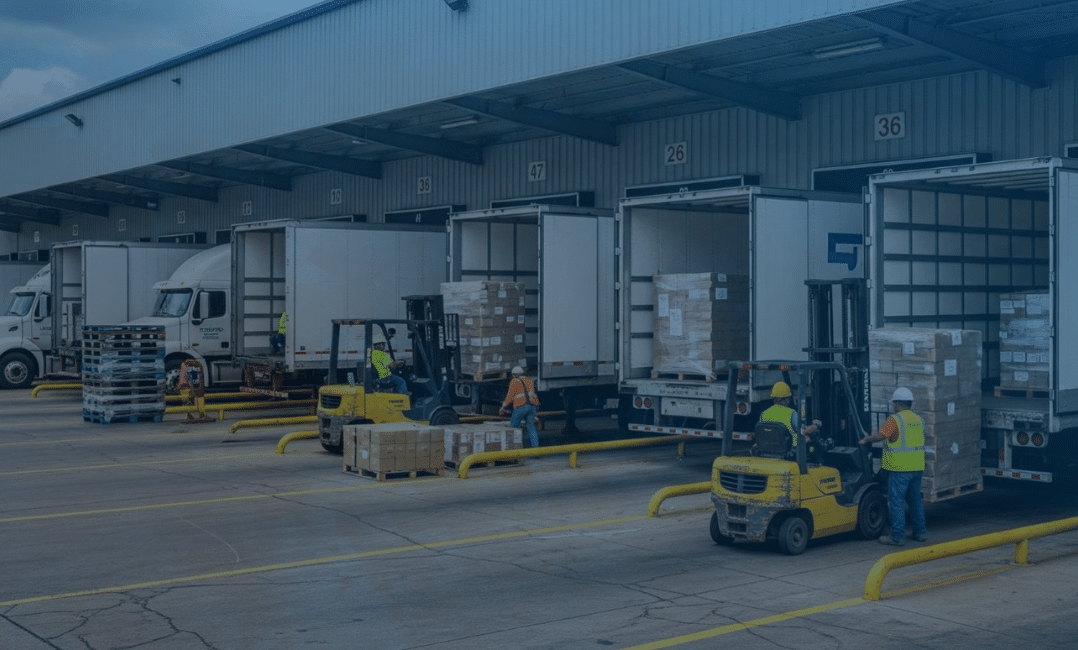
- Dock height, so loading doesn’t change. Trailers sit at about 52 inches. Forklifts drive straight in from the dock, the same way they move product everywhere else in the building.
- Add or return units as volume moves. Need more for peak? Add them. Volume drops? Call and we handle pickup. No capital project, no long-term lease.
Here’s the limit, plainly: a storage trailer isn’t a staffed, climate-controlled building. If your growth needs more people, more production space, or climate control, trailers won’t replace that. What they do is hold product at your dock while the permanent answer gets sorted out.
Using temporary capacity as a bridge
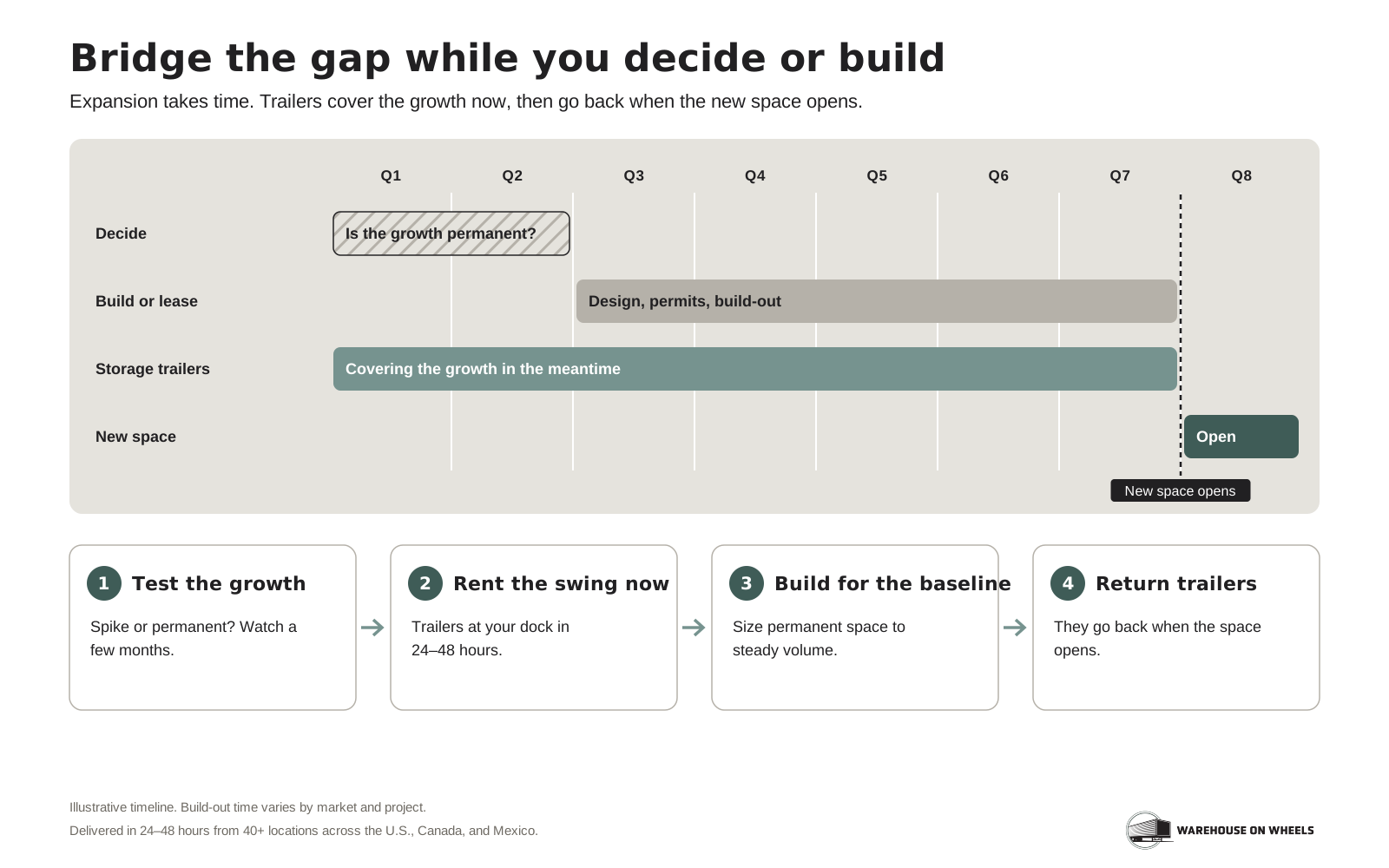
Temporary capacity works best as the bridge between today’s full floor and a permanent decision made on good data. It earns its keep at three points.
While you watch whether demand holds. If the tests above came back mixed, you don’t have to guess. Put trailers at the dock, run another season, and let the numbers tell you whether the growth is real. A capital decision made with twelve more months of data is a better decision.
During approvals and construction. Once you commit to building, the space problem doesn’t wait for the ribbon cutting. Trailers carry the overflow through permits, construction, and fit-out, then go back when the new space opens.
While you move. Relocations rarely line up cleanly. Trailers hold inventory between the old lease and the new building.
Kelly McCane, general manager of our Walton, Kentucky location, saw the bridge play out in real time. A customer had 152 rail containers coming in from California and a warehouse with roughly a quarter of the room it needed. They planned to squeeze it all in. When the containers started landing, they called Kelly. The Walton team staged rent-ready trailers, brought in extra drivers, and had trailers on the ground within about four hours. The customer unloaded every container into trailers and kept going until they moved into their new warehouse. They’re still a customer today.
“It’s nice to be that calming effect that you can have on somebody when you tell them, ‘Don’t worry, we got this. We do this all day, every day. We’re gonna help you out of your jam.'” Kelly McCane, General Manager, Walton, KY
A simple way to decide
Expand for your baseline, never for your peak, and cover the swing with temporary capacity. Here’s how to find each in four steps.
- Plot your need. Chart the pallets (or trailers’ worth of product) you needed to store each month for the last 24 months, against what your building holds.
- Find your new baseline. It’s the lowest month in the most recent 12. If that baseline is already above your building’s capacity, and it was the year before too, you have permanent growth to plan for.
- Call everything above the baseline swing. Swing goes to temporary capacity every year, even after you expand, so you never build for your peak.
- Match each to a path. Baseline over capacity? Start the expansion plan and cover the gap with trailers until the new space opens. Baseline under capacity? Cover the swing with trailers and check again next year.
When expansion is the right call
Expansion is the right call when growth has become your baseline and you need more than storage. Build, add on, or move when:
- Your baseline has sat above capacity for two years running
- Volume is steady year-round, with little swing between months
- You need climate control, more production space, or a larger staffed operation
- You have a long planning horizon and the capital to match
If that’s you, expand. Temporary storage is the wrong tool for a permanent need, and we’ll tell you so. Storage trailers then become the bridge, not the answer: they carry you through construction and keep handling the swing after you move in.
Build the case for leadership
Whichever path you pick, leadership will want the gap sized and the options compared before anyone signs. Start by putting numbers to it in the Savings Calculator.
The short version on cost: an expansion commits capital up front and carries its costs every month after, whether the space is full or not. Storage trailers cost only as long as you have them, and they go back when you’re done.
Frequently asked questions
How long does a warehouse expansion take? Months to years, depending on scope, approvals, and your market. Building new usually takes longest; adding on can be faster but runs alongside your daily operation.
Can storage trailers stay while an expansion is under construction? Yes. Trailers rent month to month, so they stay as long as the project runs and go back when the new space opens.
Is temporary storage just putting off the inevitable? Only if the growth is permanent and nobody’s planning for it. Used well, temporary capacity buys you time to decide with real data, and it keeps handling the seasonal swing even after you expand.
What if we expand and demand drops? Then you’re carrying space you don’t use, every month. That’s why the rule is to expand for your baseline and cover the peaks with temporary capacity.
How fast can we add temporary capacity? Warehouse on Wheels delivers storage trailers in 24 to 48 hours from more than 40 locations across the United States, Canada, and Mexico.
Not sure whether your growth is a spike or your new baseline? Size the gap before you commit capital.
Run your numbers in the Savings Calculator
Get a quote or talk to your local Warehouse on Wheels team about covering the gap in 24 to 48 hours.