
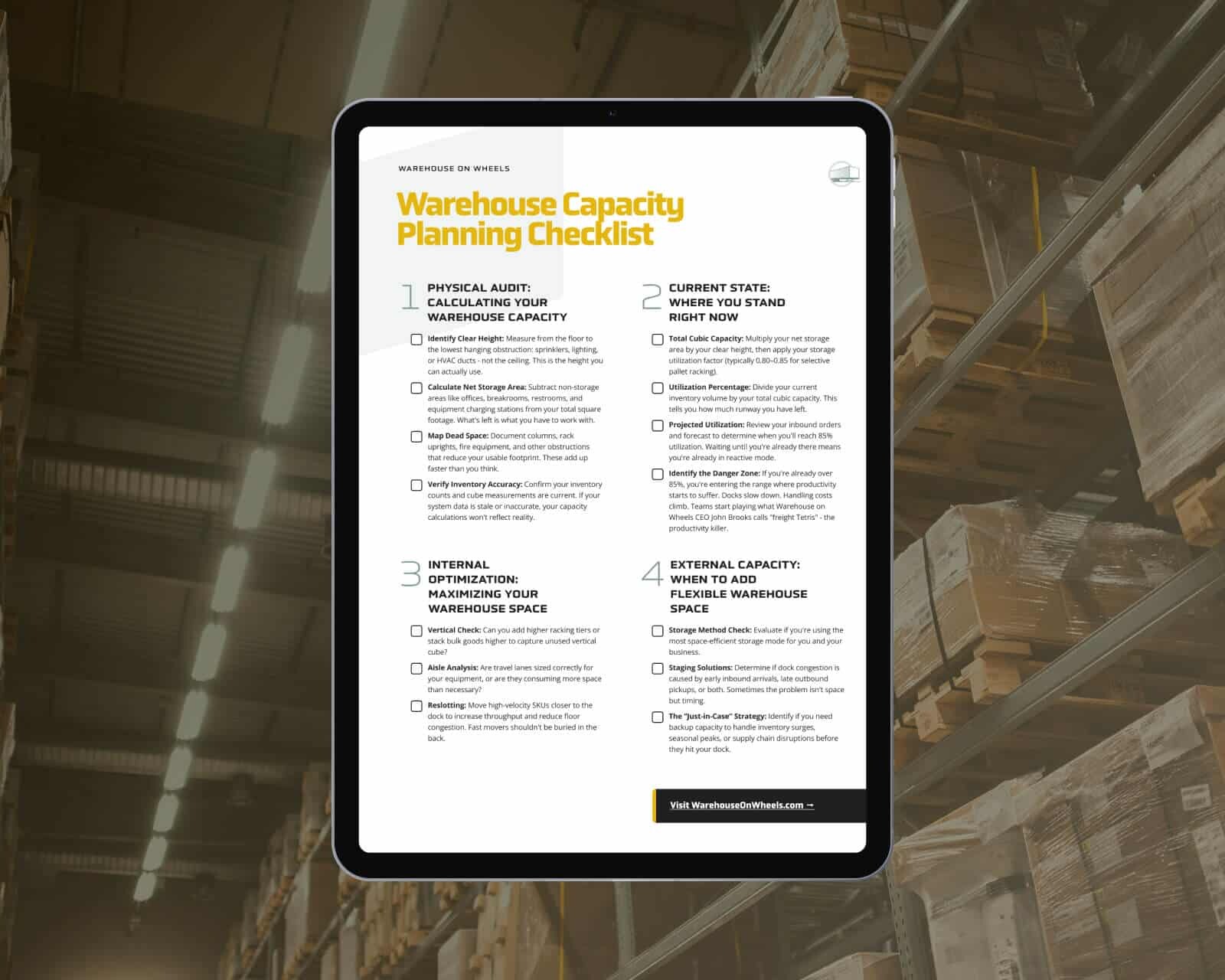
Warehouse Capacity Planning Checklist
You’ve read about capacity constraints, dock bottlenecks, and the productivity drag that hits when traditional warehouse space runs short. Before you pick up the phone or commit to a long-term lease, here’s how to verify you’re actually at capacity, and how close you really are to the breaking point.
1. Physical Audit: Calculating Your Warehouse Capacity
- Identify Clear Height: Measure from the floor to the lowest hanging obstruction: sprinklers, lighting, or HVAC ducts – not the ceiling. This is the height you can actually use.
- Calculate Net Storage Area: Subtract non-storage areas like offices, breakrooms, restrooms, and equipment charging stations from your total square footage. What’s left is what you have to work with.
- Map Dead Space: Document columns, rack uprights, fire equipment, and other obstructions that reduce your usable footprint. These add up faster than you think.
- Verify Inventory Accuracy: Confirm your inventory counts and cube measurements are current. If your system data is stale or inaccurate, your capacity calculations won’t reflect reality.
2. Current State: Where You Stand Right Now
- Total Cubic Capacity: Multiply your net storage area by your clear height, then apply your storage utilization factor (typically 0.80–0.85 for selective pallet racking).
- Utilization Percentage: Divide your current inventory volume by your total cubic capacity. This tells you how much runway you have left.
- Projected Utilization: Review your inbound orders and forecast to determine when you’ll reach 85% utilization. Waiting until you’re already there means you’re already in reactive mode.
- Identify the Danger Zone: If you’re already over 85%, you’re entering the range where productivity starts to suffer. Docks slow down. Handling costs climb. Teams start playing what Warehouse on Wheels CEO John Brooks calls “freight Tetris” – the productivity killer.
3. Internal Optimization: Maximizing Your Warehouse Space
- Vertical Check: Can you add higher racking tiers or stack bulk goods higher to capture unused vertical cube?
- Aisle Analysis: Are travel lanes sized correctly for your equipment, or are they consuming more space than necessary?
- Reslotting: Move high-velocity SKUs closer to the dock to increase throughput and reduce floor congestion. Fast movers shouldn’t be buried in the back.
4. External Capacity: When to Add Flexible Warehouse Space
- Storage Method Check: Evaluate if you’re using the most space-efficient storage mode for you and your business.
- Staging Solutions: Determine if dock congestion is caused by early inbound arrivals, late outbound pickups, or both. Sometimes the problem isn’t space but timing.
- The “Just-in-Case” Strategy: Identify if you need backup capacity to handle inventory surges, seasonal peaks, or supply chain disruptions before they hit your dock.
What Comes Next
The math doesn’t lie. If your utilization is pushing 85% or higher, you’re running out of time before the operation starts to feel it, slower docks, more double-handling, missed shipping windows.
If internal optimization is maxed out, the next question is simple: how much additional capacity do you need, and how fast? Traditional warehouse expansion takes 6–18 months. But temporary surges, seasonal peaks, and uncertain demand require faster, more flexible solutions.
The good news? You don’t need to solve this with a five-year lease or a construction project. More than 7,000 companies, from startups to Fortune 100, rely on Warehouse on Wheels for exactly this: mobile storage delivered in 24 to 48 hours, without the commitment.
When you’re ready to add breathing room to your operation, we’re here to help.